Sunday, November 29, 2020

Test Me Test Me, Why Don't You Arrest Me

It's Sunday morning as I write this, and yesterday I played in the MTG Arena Zone Open on MTG Melee. I really like these events because they're carefree, free to play, and nothing to win or lose but bragging rights. Of course, if you know me, bragging rights are the only currency I care about.

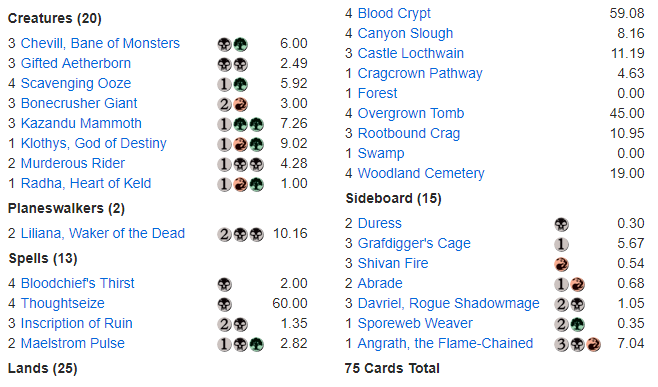
Here's the list I played.

In classic Griffin style, I wrote all about how I liked Knight of the Ebon Legion but not enough to play it, then decided later to play it. It was solid. It has a low floor because it's only one mana to cast, and it doesn't need a lot of other things to go on around it in order for it to be good. It also pressures your opponent's life total pretty well, since you can trigger its counter pretty often between either beatdowns on your opponent or Locthwain, Thoughtseize, and Shocklands on yourself. I'm also only playing three copies at the moment, which works well for Knight because they are okay but not ideal in multiples. Playing only three Glint Sleeve Siphoners or Magmatic Channelers seems pretty loose since Siphoners are so good in multiples and Channelers need deckbuilding work to maximize.

I also am up to four four-mana planeswalkers in the deck, two Chandra, one Liliana, and one Vraska. Having a mix gives you the effect that we're looking for, but avoids the legend rule. I think that Chandra is the best of them, but all three are solid in the format at the moment.

In the sideboard, I decided to go with my 3x By Force plan. I never ran into the Forsaken Monument deck, but there were a couple running around and it felt good to be prepared.

I ended up playing against Sultai (or Yasharn Sultai) three times and Esper Yorion Doom Foretold once. The swiss was only four rounds because there was a pretty light turnout, whereas earlier iterations of this tournament had over one hundred the times I played it previously. I think that they hadn't run them for the last few weeks here for whatever reason, but hopefully they pick up steam again. It's a fun time.

I won my first match against Sultai. Scavenging Ooze did a lot of work to make sure I never had to deal with Uro, and I ended up just killing them with attackers and discard spells.

What's nice about the Sultai matchup is that you don't necessarily have to attack them to death with small creatures, but if you do that can certainly work. You just need to have some plan to either gain some leverage from your tempo or to out-grind them in the long game. That seems like it's hard to do against the Uro and Hydroid Krasis deck, but Castle Locthwain gives us a big edge in that regard, as does stuff like Inscription of Ruin, Chevill, Ooze, and our Planeswalkers. Add to that we play 24 lands, three of which are Locthwain and four are cycling lands, and we also are drawing way more spells with our card draw throughout the game.

In the second round I was paired against Esper Yorion Doom Foretold and lost quite badly. It's a pretty tough matchup but I have been able to beat similar decks in the past. I beat Sultai again in round three but then lost to it in round four in what later I found out was a win-and-in. Nothing really special about the match, just had draws that didn't really cooperate.

All in all, I really liked the decklist. I think if you can average beating Sultai twice out of three times with a deck like this, then you're in really good shape. I managed to hit a slice of the metagame that wasn't exactly hostile to us, but also not ideal, and had a solid shot at Top 8. The only real change I'd be interested in making would be to add a Kazandu Mammoth back into the list somewhere. Having a little extra green mana to make better use of Scavenging Ooze would help in a lot of matchups.

Thanks for reading. If you get a chance, check out the MTGAZone Historic Opens, that hopefully will pick back up to every weekend from here on out. They're a really fun time and a good way to get some high quality reps in. See ya later.

Sunday, November 22, 2020

The Heat Came By And Busted Me

Here's where I'm currently at.

And when I say I'm currently at, very little of this is set in stone or proven. Jund Midrange in Historic is getting a little bit of traction at the moment and I don't think that anyone has anything close to a set in stone list ready to go.

Crokeyz, who has got to be Magic's number one streamer right now, played this list recently. It's got no Chevill and includes Knight of the Ebon Legion. It's also got no double face cards, so no Mammoths and no Shatterskulls, but it includes all four Chandra and all four Bonecrusher.

Bonecrusher I can get behind right now. As far as Knight of the Ebon Legion goes, some folks swear by it. For me, it's clearly a strong card but it doesn't do what I'm looking for. I think Ooze is certainly better as far as a card that you can cast early and dump mana into late, but maybe there's more room for that kind of effect. I think the difference is that my list has more mana sinks, most notably Castle Locthwain, and it's also not as aggressive on the opponent's life total, where Knight shines. If you're looking for a more aggressive slant to the deck, then it's really good there. It just feels like the strategy of casting Chevill and Knight are at odds with each other. I'll test some more, but I like the threat suite that we have. The cards complement each other pretty well.

Speaking of that, folks in the social medias were talking about Glint-Sleeve Siphoner. I gave it a shot, mixing around some stuff to include it in place of Channeler. I was impressed. Siphoner definitely is a card that doesn't need extra help to get some good work out of it. It's a little like Bitterblossom has been in Modern for me, where on it's face it looks like you want some Scion of Oona or Intangible Virtues to get the best out of it, but by itself it's just a really good card. Running no copies of Aether Hub or Attune with Aether, to say the least of Harnessed Lightning et al, Glint-Sleeve Siphoner held its own. It was really good in matchups where my life total didn't matter that much. That's not necessarily because I was losing 1 life to draw a card, it's because it had pretty low ability to block. That was the kicker for me, that Channeler was a better defensive card early in the game and good on offense late, the right kind of timing for this deck. Glint-Sleeve was offiensive all the time. I think that you could change some numbers around to make the deck more Glint-Sleeve friendly and have it be better than our current list against some portion of the metagame, but again, it's a little more matchup dependent than I'd like when there's a perfectly good substitute that isn't.

Shatterskull Smashing has been impressive to me. The double faced cards are always going to be pretty good, but Shatterskull is even more versatile than the most versatile cards, and unlike the rest of the mythic double faced lands that were printed, it's good early too. Emeria's Call is great when you have seven or more lands, but Shatterskull is still good if you have five or six. Creatures in this format are often small but still dangerous, and if we can make sure we're keeping up with them with cheap removal, Shatterskull ensures we don't run out of gas later. Plus, it's an amazing draw on turn 12, unlike Mammoth which is better than a land in the super late game but not as good as Shatterskull. It reminds me a little bit like Bonfire of the Damned, but with a lower ceiling and higher floor, and that card was phenomenal in its day.

It's just a one-of in my list above, but I have been trying out Grakmaw a little bit and haven't hated it. Then I figured, well if we're doing Grakmaw, how about we roll with the original Grakmaw? I think we can afford one big drop in the deck, especially if it's the kind of card that can shift a race when it comes down, and five drops get better since we're running Chandra instead of Liliana these days. The reason I like Thragtusk is because it's the five drop of the format that's best against black decks, which seems to be the most popular color these days, but it's also huge to resolve one against a U/W Control deck. Whereas Elder Gargaroth is a liability against a Murderous Rider or Teferi, Thragtusk excels in that scenario, while still being a big stop sign to anyone pressuring your life total. If a five-drop has a place in the deck, I think that this one is the one, for now, although I also like Angrath quite a bit.

What do we do about Forsaken Monument? Well, I've started trying to help that by adding one copy of By Force. I think By Force against the Monument deck is just about as close to an instant win as exists in Magic, but what matters is how many copies we can afford to play. Unlike Grafdigger's Cage, it's really only great in the one matchup, but it's okay-ish in a couple of others. If the Monument deck keeps showing up, it might be right to add more copies to the board. But then the question becomes, what do we take out, followed by the other question, what do we do to the maindeck to fix the matchup that we just cut sideboard cards for? Brad Nelson says that it's more important to have an anti-aggro main deck and fix the rest with the sideboard, and I have to say that I mostly agree. That said, I still want some action to bring in when I cut my Thoughtseizes against the aggro decks of the format, and what's nice is that Abrade is great in that capacity and against Forsaken Monument. I'm not ready to pull the trigger yet, but should the day arise, I think we go to four Abrade in the board and no Fatal Push or other one mana removal spells, then lower our curve in the main a little bit. Something like this:

4 Abrade

3 By Force

3 Grafdigger's Cage

5 Discard spell/value cards, like Angrath, Liliana, Duress, Davriel, Casualties of War

Big mana decks are usually a big problem for low-to-the-ground midrange decks, but if the tools are available in the format, you can beat it, if you want to. That's a real question though, because the cost is your sideboard space, but if you really want to, you can take this thing down.

~

Thanks for reading. I'm hoping to fire up the stream some more this coming week, since I'll be not traveling. Stay safe out there.

Monday, November 9, 2020

Close the Gap on the Dark Years In Between

Hardest part of writing a blog is thinking of Grateful Dead lyrics use for the title.

Anyways, Kaladesh comes out in a couple days and I just want to go over some stuff. I've been getting some good questions from folks on Reddit and Discord about Jund in general and the list moving forward, so I'll address some things that have been popping up.

On Chevill

Some folks ask about Chevill. I never really talked about Chevill in this blog because I just wasn't writing at the time when it was released and Chevill became a staple, to me, immediately, so it kind of didn't come up.

Personally, I saw Chevill in the spoiler and was hooked. I quite often get attached to a card and have to teach myself to let it go when it doesn't cut the mustard. This was not the case for Chevill. It overperformed from day 1 and I never looked back. I've played up to 4 and been happy with it.

The best analogy I can make to Chevill, at the same mana cost, would be something like Stoneforge Mystic with higher upside but a lower floor. We want to be killing our opponent's creatures anyways. Chevill offers us cards and life for this exchange, that you plan on doing like five times a game. It's not uncommon to be up five cards and 15 life for a 2 mana investment.

Chevill's floor is also really high. It's a 1/3 with deathtouch, which is already a huge pain in the ass for a lot of Historic decks. You can't really attack into it with anything that's the same mana cost or less, so usually your worst case scenario is your opponent has to take a turn off from casting threats to play a removal spell, or you trade with a more expensive creature. Being a good deal to trade off with helps negate the legend rule.

That's all well and good against aggro decks, which makes up a large part of the Historic format for what it's worth, but how about the rest of the field? Chevill doesn't attack especially well, but he doesn't need to. Trying to keep pace with the card advantage from stuff like Teferi and Narset used to be impossible, but if you're able to draw a card each time you Maelstrom Pulse or Bloodchief's Thirst an opposing Planeswalker, all of a sudden your removal spells are good instead of a liability. Also note that with Thoughtseize and Castle Locthwain in the deck, life gain is appreciated in matchups that normally would not need it.

I like Chevill a lot.


Cutting Red

I think there are plenty of arguments for cutting red. It may even be right to do so. This isn't great evidence or anything, but every time I do that, it doesn't feel right to me. Red cards offer the best cheap removal most of the time. In Modern this manifests as Lightning Bolt, Forked Bolt, Flame Slash, Terminate, and Dreadbore, but in Historic, Bloodchief's Thirst, Eliminate, Heartless Act, and now Fatal Push are probably the most efficient removal spells in the format. So we're sort of covered there, but I still like Abrade and Shivan Fire out of the sideboard. We also don't need to play Magmatic Channeler instead of the next best black or green value creature, and we don't need to play Chandra, Torch of Defiance instead of Vraska, Golgari Queen and Liliana, Waker of the Dead, but they are better.

My biggest gripes with the straight Golgari versions of this deck, though, is that the mana isn't that much better than with red. The cost of playing red isn't that you often miss a color, which happens but rarely, it's that you have to play lands that enter tapped or cause you damage. The mana requirements, even in Golgari, don't really allow for the use of colorless value lands, like Crawling Barrens.

I think Temple of Malady and maybe Field of Ruin if you're interested are the only big gains you get out of cutting Red, right now, and you lose out on efficiency. Jund feels like a sleeker, more efficient strategy to me, in basically every format I've tried it. If you feel different, then by all means, and you could very well be right. But I'm happy with the Red for now.


Kroxa

Patrick Chapin (I think) said that you never want to be a worse version of someone else. I played Kroxa in the past and it was good, but I don't think the deck is set up to utilize it very well right now with our Kazandu Mammoths, and I don't think the format is in a place where we can play Kroxa the fair way and make it work. Casting Kroxa for two mana isn't something I'm interested in while Burning Tree Emissary is legal. That's to say nothing of running into the graveyard trap and having our opponent's Rest in Peaces and Grafdigger's Cages and Scavenging Oozes do work against us. If you're willing to have graveyard hate be really good against you, then you should just play Rakdos Arcanist or Jund Sacrifice. Kroxa is certainly powerful and is good in matchups where we could admittedly use help, but I haven't missed it since I cut it from the deck a few months back. If you want to play with Kroxa, I'd suggest playing Elder Gargaroth or Glorybringer instead, which are huge creatures that have lots of impact on the board and actually cost less mana overall.


Glint-Sleeve Siphoner

This is a card that seems like it's perfect for this deck, and I'm definitely going to give it a try, but I don't have high hopes. I had someone in my twitch chat mention that they hope that Dark Confidant gets injected into Historic, and while I love Bob, it's not at the top of my wish list. Historic is fast, the aggro decks are really aggressive, the removal spells are cheap, your life total is taxed, and winning games comes down less often to how many cards you drew and more often how many cards you had time to cast. Remember that Dark Confidant in Modern is drawing you into stuff like Nihil Spellbomb and Damping Sphere and Anger of the Gods, whereas in Historic you'd be getting stuff like more copies of Maelstrom Pulse. Which is fine, but not always worth the cost of the undersized body that attacks your own life total.

Having said that, Siphoner is really good in conjunction with stuff like Attune with Aether and Winding Constrictor, and if you're headed down that road, there's Rogue Refiner and Confiscation Coup or Harnessed Lightning and Longtusk Cub. It's hard to say if the Energy package is going to be the way to go with midrange or not, but it sure was good while it was in Standard. I know I love my Chevills, but even I have a tipping point.


How's the Sultai Matchup?

It's good. Intrinsically it shouldn't be, but I've tested a lot of stuff out and have a plan that works. It wouldn't be good if Scavenging Ooze wasn't as good as it is. But not only do we play four Ooze, we also play three Inscription of Ruin to get it back. That said, it's really hard to play, plus they draw lots of cards and make lots of mana, and we aren't super fast. However, once we get into the late game, we're able to keep up on cards pretty well with our Planeswalkers, Inscription of Ruin, and Castle Locthwain, and I really like our sideboard plan. There are lots of games where you're like, "Aw, jeez, Uro again" and think you're screwed but you can sometimes just grind it out anyways.


How's the Blue/White Matchup?

It's ok. You need a lot of things to go right because their card advantage engines come online pretty fast if you stumble early, but you also need to have a sustained ability to present threats later on. It's totally doable though, and Castle Locthwain is extremely good because they don't pressure your life total hardly at all. We have a good sideboard plan and also don't necessarily need to walk into Wrath, so that's helpful. Each individual creature we present is good enough to essentially win the game by itself, so they all need to be dealt with. This is the matchup I'm looking to improve the most going forward, but Kaladesh might totally revamp the format, so who knows.


Now that the contents of Kaladesh are known, any changes to the deck?

This is the list I posted in the last post, a too-early-look at a post-Kaladesh Jund list. Since then the contents of the set were revealed, and nothing extremely out of the ordinary is in it, with some interesting little details.

No Felidar Guardian means we don't have to worry about Saheeli Rai combo. This makes it so we aren't pressured to play stuff like Eliminate or Bonecrusher Giant and hold up mana for it against control decks. Dedicated combo decks aren't that bad, and dedicated control decks aren't that bad, but decks that get to do both become real problems. Anyways, problem solved!

No Smuggler's Copter means that I'm even less incentivized to play Fatal Push over Bloodchief's Thirst. Heart of Kiran and Aethersphere Harvester will still exist, but they're slower and will be less prevalent. For what it's worth, I kind of like Smuggler's Copter being in the format, mostly because I don't see the downsides as downsides. The ubiquity amongst aggro decks, the low opportunity cost, the hard to deal with permanent type, not really that big of a deal to me, but I also like Umezawa's Jitte so I'm probably taking an L on this one.

No Walking Ballista means that the Forsaken Monument decks will not get better, which is good because that matchup is a nightmare for us. It also means that Winding Constrictor Energy decks won't be as prevalent and Whirler Virtuoso looks a little better. Outside of the Forsaken Monument decks, I'm not sure Ballista would have been a huge player in the format, but it's seeing play in stuff like Vintage all over the place so I'm probably wrong.

The inclusion of Aetherworks Marvel is scary, but we didn't have Grafdigger's Cage back when Marvel was first legal.

After everything, I don't think that there's anything I really want to change on day 1 of the set from the list I've posted, but this deck is definitely a work in progress, as is the whole format. I would imagine that a week from now it'll look quite a lot different, and I'll let you know then.


Why no Fatal Push?

I think that it's too inflexible, and we can't utilize the Revolt mechanic in this deck at all. Reid says that it's impossible to have a matchup that's too good, but we're already beating up on aggro decks and lacking against control. It's certainly possible that I should have it in my sideboard over Shivan Fire and Disfigure, though. We'll see. I want to be clear that I don't think that Fatal Push is a bad card. Fatal Push is extremely good. During the Bolt vs Push debate when Push was printed, I played this in Modern. It's very good, but Bloodchief's Thirst is also very good, and I think Thirst fits this deck and the format better.


Why not more Klothys?

I have to admit that Klothys is a card that I rejected for a long time but finally decided to give it a spin and now I'm wishing I had done it sooner. However, I've always been afraid to go above one copy, and that's because Klothys is uniquely hampered by its Legendary status. It's really hard to get this thing off the table, so it's really hard to make use of the second copy you draw. Is that cost worth adding another one or two? Possibly, but I feel pretty secure in my matchups where I desperately want this thing, so one has been good for me so far. Similarly, Radha is a legend rule trap herself, because she helps you dig into action so well that you're more likely to find yourself another copy of Radha. Anyways, if you want to take the risk and throw more copies of these two cards in, then go for it.

~

That's about it for me. Thanks a lot for reading, it's cool to see people get interested in an off-the-beaten-path style of deck. If you have more questions, I love talking about Jund probably even more than I love playing it, so feel free to comment here, harass me @griffinzoth on twitter, or catch me in the r/mtgHistoric discord channel. Also I stream on twitch and have a Youtube page that I'm thinking about getting up and running again. See ya soon.

Sunday, November 1, 2020

Rainbow Spirals Round and Round

 Kaladesh Remastered

There are two things to discuss when planning out the near future for the Historic Jund deck. Well, I guess three, one of them being "Is the deck where we like it right now?" I think for that, the answer is yes, but there are plenty of little changes you could make to ratchet up your ability to win certain matchups. Right now, it seems to work really well against aggro decks but is lacking against control decks. That's fixable, but tough to accomplish without teetering the seesaw and then you'll lose to Gruul and Red and whatnot. Anyways, what we want to figure out today is 1. What will the format look like going forward, and 2. What do we want to add to the deck?

If you remember from when Kaladesh was in Standard, it was a very powerful couple of sets. There was a definite aggressive slant with cheap creatures like Bomat Courier, Toolcraft Exemplar, and Scrapheap Scrounger. These aggro strategies kept in check the Energy decks, one of the main mechanics of the set, and there were a few ways to build Energy, either aggro, midrange, or combo.

I think that all of these things are good enough to see play in Historic. Toolcraft Exemplar enters the format as the closest thing to Wild Nacatl we've got, so if that deck becomes popular, our low-to-the-ground Chevill plus removal plan will continue to be good. Rogue Refiner and Longtusk Cub and Harnessed Lightning are good synergy cards that also have high ceilings and are looking to grind. The cards are consistent and powerful, they work great together, and you can imagine that Uro might find its way into a Blue and Green midrange deck as well. Fighting these decks will look a lot like the way we fight today's Sultai midrange decks, with discard, value plays, and trying to keep Uro off the table.

Some unknowns from Kaladesh Remastered are whether or not WotC wants to put cards that were formerly banned in Standard into Historic. Smuggler's Copter ate a ban early on in its Standard tenure, Aetherworks Marvel was banned shortly after, Felidar Guardian was banned and deemed to be a mistake, and eventually Attune with Aether and Rogue Refiner met similar fates. Copter and Walking Ballista are also banned in Pioneer, for what it's worth. It's unclear if these banned cards will be put into Kaladesh Remastered, and also whether some new goodies will be put in, like Thoughtseize and Collected Company et al were thrown into Amonkhet.

I'm most interested in finding out about Felidar Guardian. For a hot second, Felidar Guardian and Saheeli Rai in Jeskai control decks looked a lot like Splinter Twin. Outside of that, Kaladesh's best stuff was not necessarily pure control cards, but the Felidar Guardian package added a lot to existing control strategies. If Felidar Guardian is legal, I'm interested in trying to give ourselves more instant speed interaction. This could mean Bedevil to deal with Saheeli Rai, Heartless Act or Cast Down to hit Felidar Guardian, or whatever works. The idea previously was to make sure your anti-creature spells could hit your opponent's planeswalkers, now we want to bust up their combo as well.

So what does that mean we're playing, moving forward?

Blooming Marsh is an upgrade to our mana base for sure, but we run into the same problem we ran into when Cragcrown Pathway was spoiled. Can we afford to bust up our Shockland/Checkland combo? I think the answer is yes, since Blooming Marsh is so good, and if every once in a while our Castle Locthwain comes into play tapped, then that's okay.

How about Fatal Push? Well, this card gets much, much worse when you don't play fetchlands, and I don't think we want Fabled Passage. It also runs into the problem of being a dead card against a lot of decks, which Bloodchief's Thirst does not. For now I think that Bloodchief's Thirst is just a little bit safer.


I've been really into Chandra Pyromaster out of the sideboard lately, but Torch of Defiance does all of that and more. She's perfectly maindeckable, since she's a removal spell and a value engine in one. She's flexible, has a big effect right out of the gates, and threatens to run away with the game, even ultimating and winning the game by herself. What's nice is that we're aggressive enough to take advantage of the +1 ability dealing 2 damage when we don't want the card. To really maximize Chandra, ideally we have a way to utilize the two red mana on turn 4 and turn her into a 2 mana planeswalker. Magmatic Channeler is perfect for this, but red removal spells also get a little bit better when Chandra is in your deck as well. Bonecrusher Giant and Cut/Ribbons start to look a little better when they cost 0 mana. Extra mana on turns you untap with her make Shatterskull Smashing look much better as well.


Do we want to move towards the Winding Constrictor Golgari Energy package? My gut feeling is that Constrictor itself is too bad of a card when not working in synergy with your other stuff to be exactly my personal style of deck, and that Glint-Sleeve Siphoner's stats are a little too low impact for the format. Constrictor works really well with Scavenging Ooze, however, so maybe there's something there. If you decide to go this route, I can't imagine that you'd want to run a midrange Energy deck without Rogue Refiner. Maybe 4 color Energy is viable? It's worth a look. Aether Hub and Attune with Aether make lots of crazy things possible.

Here's a way too early look at Jund:


I like this MTG Goldfish Visual View thing. We've got some cool stuff to do with RR added to our pool, including Cut/Ribbons. The mana is going to be a work in progress for sure, but I like the ratios as they are now. All of this is up in the air, of course, since we don't know what will and won't be exactly in the Kaladesh Remastered set list, but I'm happy and excited with this list. Thanks for reading, and check out the twitch stream if you're interested. See ya!

Tuesday, October 13, 2020

Don't Shake The Tree When The Fruit Ain't Ripe

Years from now, we'll think to ourselves, "Remember that three week stretch where Omnath was legal? What the hell was that?"

I want to talk about three things today: Magmatic Channeler, Omnath, and I guess just bannings in general. Everyone has an opinion on Wizards design as of late, but whatever.


I've added Magmatic Channeler to the Historic deck. Having taken out Murderous Rider already, the only thing to do was throw in a few more instants and sorceries and we were off to the races. Bonecrusher Giant is a great card, but I haven't missed it.

Channeler certainly has that Tarmogoyf feel to it, where it's a 2-drop but it's a good draw step late in the game as well as early. That is certainly a welcome addition, but the other thing that's good with Channeler is that we play cards that are versatile, so it's likely that one of the two cards you hit off of it will be something you want. Maelstrom Pulse is great here, but so is Inscription of Ruin, which is a card I really hoped would be good that has exceeded expectations. Kazandu Mammoth fits in this category as well, being a land drop if you need it or a threat that's perfectly serviceable. Late game Thoughtseizes and extra lands can turn into gas, plus it turns dead cards in your hand into action that's outside of your hand, which helps with Castle Locthwain and Liliana.

Gifted Aetherborn was certainly a card I liked, but it's just a role player. I mean, so is Channeler, but I think it's better. Double-black on turn two isn't exactly the best thing, especially with Kazandu Mammoth in the deck, so Channeler is definitely better on that front.


So this thing was clearly too good for Standard, but in Historic we were beating it pretty well. Omnath the card is absolutely a mistake to print, just kind of an unprecedented combination of rate and synergry potential. However, as a deck, I don't even think it was the best deck with Uro in it. In a format where you can have your best pieces Thoughtseized, you can have them countered, you can have your mana-generating creatures killed easily and have your expensive cards stuck in hand, or you can just be attacked for 30 out of nowhere via Neoform or Bolas's Citadel or Muxus, Omnath turns from the clear best deck to a deck that's explosive but not necessarily much better than others. It absolutely could have been the best deck in the format, looking at win rate numbers, but so much so that it had to be banned?

As far as we're concerned, I was able to beat Omnath pretty regularly with Jund. Not 100% or anything, but for a deck that plays out like a Vintage deck, I wasn't awfully scared of it. I never really made any significant changes to the list to try to beat it, save maybe being one factor in swapping Murderous Rider for Maelstrom Pulse. The Omnath experiment was silly.

Bans

This rant is going to get off topic. There's a lot to talk about in regards to WotC's decisions over the last few years. I think it's important to view everything that's happened from a lens that identifies that Wizards is a company that is making an effort to make money. Also, there has been a well-documented push in the last four years or so to take a profitable company and make it more profitable, as requested by Hasbro, the corporation that owns Wizards.

This important for a few reasons, but it's important to diagnose the problems with Wizards' actions with that in mind. I'm absolutely not in favor of attacking or criticizing the game designers themselves, many of whom are Twitter active and formerly public pro players, not necessarily to protect them, although there's that, but also because they're most likely just following orders, or at least under different pressures than they were 8 years ago when Magic was at its peak. When I order a drink from a bartender and they put well vodka in it instead of Grey Goose, it's tough to blame the bartender instead of the owner who told them what they can and can't do, or how much of a margin they need to be hitting.

Another thing that comes up a lot in this discussion is that, in their articles about game design, Wizards designers introduced a design philosophy called FIRE, which stands for Fun, Inviting, Replayability, and Exciting. Folks I've seen are critical of the philosophy, but I really don't think it means much of anything. Magic was all of those things in 2012 and 2006, and isn't anymore. If you put an article on the website about how we want to make Magic fun and inviting and then the best deck in the format wins by casting multiple spells for free each turn and stealing all of your lands, then it's not the philosophy's fault, you just didn't do the philosophy.

There's also the myth that Magic Arena has made Standard too easily solved and players don't get the experience of discovering what is and isn't good. Folks have been saying this for years across multiple formats, and I have never bought into it. Consider the card Death's Shadow. It was printed in Conflux, in 2009, and it became popular around 2016 in Modern. It existed, alongside Shocklands, Fetchlands, and Street Wraith, in Extended and Legacy for seven years before being identified as pretty much the premier threat of the format. Magic players aren't as smart as we think we are. Omnath is a pretty in-your-face busted card that's hard to miss, but we left a one mana 7/7 on the sidelines for seven years. There's no way of knowing, because there's no AI that you can put all the cards of a format into and have it spit out the best decks in the metagame, but I am unconvinced that the Omnath decks we saw at the Grand Finals were even tuned that well. It didn't take a ton of games to see that WURG for a 4/4 that draws you a card, generates four mana a turn, and casts Soul Feast every turn would be too good. Same with Wilderness Reclamation, Lurrus and Yorion, Oko, Uro, even Lucky Clover is obviously busted once you've seen it in play one time.

We have to remember that, in addition to having over 50% of the Standard bans in the last 20 years taking place in 2020 (in addition to the companion nerf, which we shouldn't overlook), in the last 15 years there have been only 2 cards banned before Wizards switched up their set release schedule with the printing of Battle for Zendikar. In my personal opinion, Battle for Zendikar is when Standard went from fun to not fun, and it must have been the opinion of other players, too. Tournament attendance went way down and something had to be done to the format. I don't consider those 2016 bans to be design philosophy problems, I consider them to be oversights. Maybe they could have seen that Emrakul was going to be unfun and broke a bunch of rules, the same with Reflector Mage, maybe Smuggler's Copter was too obviously going to be ubiquitous, and they straight up missed Felidar Guardian. Did anyone just put a bunch of Energy producers and Ulamogs and Emrakuls in a deck with Aetherworks Marvel to make sure it wasn't too good? Doesn't seem like it. It would be strange for the design and development team that gave us Magic's best years around 2012 also to have begun a downward spiral to ban frenzy land we're in now. That's why my theory is that the set release schedule change is the most important culprit for the state we're in. The design team is great, unless they're under a set of new pressures, be it time or financial.

And I also can't assume that I'm the only one to come to this conclusion. When you make a big change, then you start losing money, the easy thing to do is say, "that change didn't work." You know, unless your job is to be Hasbro Corporate's voice inside Wizards and if you ended up making the decision that cost the company millions of dollars, it's tough for your employment status for you to later diagnose the problem as yourself. Clearly, there are just a few more changes that need to be made to make the new big change work, like FIRE, or four big sets a year instead of Large Set - Small Set release schedule, or a change to Magic's tournament structure. Right?

It's wild to me that a company, that supposedly makes good decisions and therefore has become a big corporation, can see something like Magic, the greatest game in the world, and try to tinker with it. It's just a card game, but it's pretty emblematic of a lot of problems we have in society, in my eyes. So before I go too far off the deep end and start talking about how many yards of linen it takes to make a jacket, let me just say that I just hope Hasbro can start listening to Magic designers, who understand that sets are ecosystems and cards don't individually need to be super splashy to make a format Fun and Inviting and ultimately sell. I hope they see Omnath and Oko and companions and set release schedule bungles as what they are: huge failures, and a breach of trust with its players, that needs to be fixed.

I think there are some cards that have been banned in the last few years that shouldn't have been and they're pulling the trigger more frequently than maybe they should, but the root of the problem is that Magic sets have been less fun since Hasbro got more hands-on, and the cost of that is on us.

Anyways, thanks a lot for reading, and check out the twitch stream.

Saturday, October 3, 2020

It Don't Take Much To Get Me On The Ground


Link

Happy with this list.

Not a ton of updates to anything as of late, except that I'm interested in Maelstrom Pulse quite a bit right now. Murderous Rider is a perfectly fine card, but it doesn't shine in any of the biggest matchups at the moment. Pulse can hit Felidar Retreat, Shark Typhoon, and gives you some free wins if your opponent draws multiples of stuff. Murderous Rider's 2/3 Lifelink body isn't really doing much right now, and in the matchups where that would be good, they have sacrifice abilities to counter the spell and not let you adventure anyways.

Omnath has certainly reared its ugly, uh, head I guess. And in Historic, not only is there Uro still around, but there's Oracle of Mul Daya and Explore and Growth Spiral if you're so inclined. It's a strong deck, but Historic has a lot more tools. We've definitely moved to a place where Historic isn't just Standard plus some other stuff, it's its own beast. Omnath is certainly good, perhaps even the best thing going on, but it's beatable and amongst a crowd of other very good stuff.

I'm going to go in-depth a little bit on each of the major matchups.


Goblins

-1 Klothys, -1 Radha, -1 Mammoth, -3 Gifted Aetherborn, -2 Liliana

+3 Shivan Fire, +2 Abrade, +3 Cage

I'm not certain that this is actually the best sideboard plan, but it's what I've been going with. Mostly, I'm on the fence about Thoughtseize, because the game will turn into a topdeck war at some point. In the first game, it's the only really good way to deal with Muxus, but when there are Cages in the deck, you're a little safer. This matchup is one of the reasons I like Abrade over Eliminate, because we can take out a Krenko, which is their only realistic way of beating a Cage that sticks. Shivan Fire, in a pinch, is also good against Krenko, while Disfigure is not for that slot. Chevill is incredible in this matchup, Ooze is okay.


Sultai/Bant/Nonsense

-3 Bonecrusher Giant, -1 Mammoth, -1 Gifted Aetherborn, -1 Bloodchief's Thirst

+2 Duress, +2 Davriel, +2 Phyrexian Arena

I very much dislike bringing in Grafdigger's Cage in these matchups. Uro is their biggest problem for you, but letting it hang out in their graveyard and waiting for them to find an answer to Cage isn't a good plan. Lately I haven't run into a lot of Ugin, so that makes Klothys a big problem for them. Try to empty out both hands and win with Castle Locthwain.


Jund Sacrifice

-1 Radha, -2 Liliana, -2 Mammoth, -1 Gifted Aetherborn

+3 Cage, +2 Abrade, +1 Shivan Fire

I like leaving in the Thoughtseizes against this matchup because Collected Company and Korvold are so deadly and it's important to know if they have Claim the Firstborn. Chevill and Ooze are great again here, of course, but don't get attached to them because they can get hit by Claim the Firstborn pretty easily. This is one of the matchups where Inscription of Ruin shines, because it deals with their best creatures but also is able to get back Ooze.


Red

-1 Radha, -4 Thoughtseize, -2 Mammoth

+1 Sporeweb Weaver, +3 Shivan Fire, +2 Abrade, +1 Cage

If you see Hazoret, then definitely don't bring in Cage. If you see Experimental Frenzy, bring in a couple, or if you don't want to, then bring in Duress. Drawing one Cage usually isn't going to make or break anything, plus it's not a terrible hedge if they have Earthshaker Khenra. I've been seeing a lot more Frenzy than Hazoret lately, so be prepared for that reality. The games themselves go about how you would expect. Protect your life total above all else. They can certainly kill you if you stabilize the board at 7 life, but 15 or something is not going to happen.


Rakdos Arcanist

-2 Liliana, -4 Thoughtseize, -1 Mammoth

+3 Cage, +2 Abrade, +2 Shivan Fire

First of all, they can't really beat a Klothys, so that's good to know. Ooze is your best card here of course, but again, don't get too attached. I like cutting Thoughtseize because it doesn't seem like it really does anything of substance. If you take their creature, they Claim/Fame it. If you take their Claim/Fame, they flash it back on Arcanist. I like just playing to the board better. I spent a long time thinking that I should use Thoughtseize to protect Cage in post-board games, but it never really works out that way. I like just having more knock-out cards than they can deal with through their Bedevil effects, and we have that in Chevill, Ooze, Inscription to rebuy them, Klothys, and Cage. Let them Thoughtseize your hand apart, sure, but if you can keep the board somewhat stable, you'll eventually draw something they can't really deal with. 

Also, why am I always boarding out Mammoth? Can't really think of anything else to take out, but also you've gotta imagine that your deck is a little more streamlined post-board that flexibility isn't quite as necessary. You can kind of adjust your land count in your 60 by trimming Mammoths.


Gruul

-4 Thoughtseize, -1 Radha

+3 Shivan Fire, +2 Abrade

If you can keep pace early, you're usually good to go. Chevill is awesome here, but don't be afraid to just throw it out there early and cross your fingers. If they have Domri's Ambush it kind of stinks, but lots of them play Primal Might instead, and even if they have it, it often means they have to take a turn off from curving out. Don't be afraid to just nail their last two cards with Inscription of Ruin to try and play around Embercleave.


Mono Blue

- 2 Mammoth, -1 Klothys, -1 Radha, -2 Inscription of Ruin

+3 Shivan Fire, +2 Abrade, +1 Sporeweb Weaver

Inscription is just a little slow for what's going on here. The idea is that you want to just have as much instant speed and cheap interaction as possible. Unlike most of the other aggro decks in the format, I don't usually like to just jam Chevill on turn 2 if I can help it. If you run into this a lot, try putting Murderous Rider back in the deck over Pulse, it's really good here.


Omnath

-3 Gifted Aetherborn, -4 Mammoth

+2 Duress, +2 Davriel, +2 Phyrexian Arena, +1 Shivan Fire

My best results against Omnath have come from turning into a control deck that seeks to win with discard and just amass more cards. That seems a little crazy, I know, but the games really don't come down to Elvish Warrior and Trained Armodon. A much better plan is to play a low-land count and answer everything you can, snag their key pieces, and keep up on cards from Chevill and Phyrexian Arena. Try to save Maelstrom Pulse for Felidar Retreat if possible, which is strangely their best card against us. Please, if given the chance to kill a Lotus Cobra, take it.

~

Magic is a weird game. Omnath is clearly the most powerful deck out there, but in a format like this, you can't really ever be too far ahead of everyone else. Historic is in a pretty nice spot right now where the power level is low enough for interesting games but the card pool is large enough to provide you with lots of answers for the stuff you might see. I like where we're at with this list, but I would imagine the Omnath lists get streamlined some and we might have to adapt. It's a tough deck to attack, but when you've got Thoughtseize and Chevill on your side, anything is possible.

Tuesday, September 22, 2020

Bebop Baby How Can This Be


Omnath seems to have destroyed Standard. Somehow, I haven't run into it in Historic. Why is that? Someone please kill me with this thing. I can't try to figure out how to beat it if no one plays it. And if the answer to all of this is "It's not as good in Historic because there's more discard and removal for Cobras" that's just serious balogna. Look at this thing! That deck plays like a Vintage deck, it's obscene. 

In the meantime, the format hasn't shaken up a huge amount in Historic. After a little less than a week of Zendikar Rising, this is where I'm at now.


I've cut all the five drops from the deck. I'm not sure that they're too slow for the format, but between Glorybringer, Thragtusk, Elder Gargaroth, or Angrath, you really want to have the right one for the right moment, and that's not super easy to pull off. If that's the case, then I'd rather have stuff that's less powerful but hits the board earlier. This was my initial thought with Nighthawk Scavenger, a card that's cheaper but has the ability be strong in the late game and close the game. Scavenger has been fine, but I cut them because I wanted another Mammoth and I wanted to add Radha and Klothys back into the deck. Don't sleep on Scavenger, depending on what you're looking for, it could definitely be right to include. With rate like it's got, you can't really mess up too bad by playing it.

Mammoth has been great. Five damage a turn is nothing to sneeze at. Mostly with Mammoth originally I was worried that the added flexibility and draw-smoothing wouldn't be worth it because neither the land side or the creature side would really be worthwhile, and I can officially say that that's not the case. By lowering the curve of the deck, a couple lands that enter tapped aren't the end of the world, so the land fits in fine. And also since we're lowering the curve of the deck, an aggressive blunt object 3-drop has a much more synergistic role in the strategy. We're moving away from the Thragtusk/Huntmaster/Bloobraid Jund strategy where you win through two-for-one threats and more of the Thoughtseize-Tarmogoyf strategy where you use your opponent's dwindling life total as leverage.

Inscription has also impressed me. What's funny is that Mind Rot is a perfectly reasonable thing to be doing on turn three in quite a few matchups, but just not enough matchups where you'd actually want the card Mind Rot in your deck. However, sometimes even in matchups where you wouldn't necessarily expect it, the Mind Rot mode turns out to be useful. If you have a board that's stable and suspect your opponent's last two cards are Hazoret or Collected Company, nail em. The other thing that makes Inscription so good is that having a Scavenging Ooze that survives is critical in a lot of matchups, and so having the ability to rebuy an Ooze in the late game is enormous, something I overlooked. Even against a board of opposing creatures that are more expensive, Ooze still is the king of a board stall.


My belief, at least for now, is that Bloodchief's Thirst is just too good of a card to not play four of. Unlike Fatal Push, drawing two of these against something like Blue White Control is not a death sentence, but similarly to Fatal Push, drawing one significantly hampers your opponent's ability to tempo you out of the early game. Just an unreasonably good card. 

In my last post, I said that I would stream an MTGMelee tournament last weekend, but some stuff came up, but this weekend I've definitely got the weekend cleared. My plan is to play in the MTGA Zone tournament that they usually hold on Saturdays at 1pm Eastern, and I'll stream it.