Wednesday, May 10, 2017

Modern - Where I'm At

So after the post I made last week, I've been doing some testing on Magic Online with Standard Jund. I could post some lists and talk about that, but it's not that interesting yet. I'm kinda on to something, but we'll see. Maybe I'll talk about that next week.

In the mean time, let's start talking about Modern.

4 Tarmogoyf
4 Grim Flayer
3 Bitterblossom
2 Tasigur, the Golden Fang
1 Huntmaster of the Fells

4 Liliana of the Veil
4 Inquisition of Kozilek
2 Thoughtseize
4 Lightning Bolt
4 Fatal Push
1 Terminate
3 Kolaghan's Command

3 Blackcleave Cliffs
2 Raging Ravine
4 Verdant Catacombs
4 Bloodstained Mire
2 Wooded Foothills
1 Polluted Delta
2 Swamp
1 Forest
1 Mountain
2 Overgrown Tomb
1 Stomping Ground
1 Blood Crypt

Sideboard:
3 Kitchen Finks
1 Eternal Witness
2 Blightning
3 Blood Moon
2 Engineered Explosives
1 Ancient Grudge
2 Shadow Guildmage
1 Duress

A while ago I got really into Joe Lossett's streams. I love his methods in deckbuilding and deck selection and I've tried to recreate that in Modern here. Joe doesn't often change decks, instead he chooses a strategy or list that he likes and works on it and works on it. Most of his streams are "Hey, I put Nahiri back in the Miracles deck, let's play some leagues," or "I added a Snapcaster for a Swords to Plowshares, let's play some leagues." It's a fantastic way to play eternal formats. You never lose the testing that you did, you can only improve your deck. You try something out, if it works, you go with it, if it doesn't you cut it.

Now despite this being a completely different strategy than Miracles, the same rules can apply. You tinker a little bit here and there, and if it turns out better, then great! You've made an improvement, now keep going. 

This isn't a normal Jund list. By the end of Joe's run with Miracles due to the Sensei's Divining Top Banning, his list looked completely unlike other people's lists, except for those who bought in to his advice. Similarly, I've been working on this list for a while now, and I'm pretty happy with where it's at. Let's talk about the deviations from the norm I've taken here:


A few years ago, Splinter Twin was the dominant deck in the format. The Twin matchup, next to the mirror match, was the most important thing to build your Jund list around. After becoming frustrated with my results against that deck, I decided that I would board out Dark Confidants for the Obstinate Baloths I had in the sideboard. See, I was pretty much never losing to the combo, I was losing to random Bolt-Snap-Bolts and Pestermite attacks, and not only did Dark Confidant hurt your life total, Bob just always died. Baloth, however, stuck around, swung the race with lifegain, and put on a clock. Maybe, I thought, Dark Confidant wasn't as untouchable as I had thought.

Fast forward to Splinter Twin's banning, all of a sudden Affinity and Infect are the two decks to beat. Dark Confidant is not good in those matchups. Bitterblossom is. I gave it a shot and haven't looked back since. It completely swings the Affinity and Infect matchups, is fantastic in the mirror, and is better than Bob against control decks because it dodges removal spells.

The time may come when I bring Bob back, since the trick is to always be tinkering. But for now, I like what Bitterblossom does for us.


Grim Flayer's card selection is a little worse than Dark Confidant's draw step ability, sure. However, what I like about it is its presence on the battlefield, creating a quick clock. See, we definitely miss Dark Confidant's digging, but in the matchups where we miss him the most, Grim Flayer is great and possibly even better. Against combo decks like Ad Nauseam or Valakut, we are trying as hard as we can to clock the opponent and find specific disruption cards. We won't miss the Fatal Push that Bob flips over en route to the Thoughtseize we need, and sometimes that piece is three cards down and Grim Flayer gets you to it ahead of schedule. Additionally, it just attacks for more damage and ends the game faster, and avoids Anger of the Gods and Pyroclasms when turned on. We don't have to board it out against Burn, on the contrary, it's one of our best cards. This is a card that I tried out kind of on a whim, but it's turned out to be fantastic.

Jund usually has a few top-end threats that are capable of taking over the board. Often they include Olivia Voldaren, Kalitas, or Pia and Kiran Nalaar. Instead of those, I like Huntmaster the best. I like that the token you get is instant value in the face of removal, which only Pia and Kiran can also say. Huntmaster also gains life, which is great and welcome in this Scavenging Ooze-less list. On top of that, it doesn't cost any more mana investment to get your value out of it. You just get to flip it back and forth by playing Magic and casting your spells like normal. Mana sinks are great, but being mana efficient is great as well, and since we're constantly worried about being slow to get on the board, I like having the fastest of the four-drops. The same holds true for Tasigur, who I like because he isn't usually a four-drop. Having Grim Flayer and not having Scavenging Ooze opens us up to Tasigur quite a bit. Tasigur's activated ability doesn't come up much in this deck, since usually they are on no cards and you have a Thoughtseize in your graveyard, but it's kind of a nice option.


No love for the Ooze? Yeah, that's right. I just don't like this card that much. It costs a lot of mana, it is only good ins certain matchups, and is easily answerable for very cheap compared to the amount paid for it. If Dredge and Abzan Company start to become more popular, then go ahead and add some of these again, but I'm not sure it's exactly necessary at the moment.


The quad laser. I want the deck to be lean. Affinity isn't gonna wait around until you have Terminate mana up.

This is a trend that I'm going to keep doing, the lowering of the mana curve. The thing is, Modern is an eternal format. As more and more sets get added, over time, the format will get faster and faster until it's similar to Legacy. Eventually, you will have to make changes when you get tempo'd out of the format. Don't wait. Make them catch up to you.


When I saw this card first spoiled, I literally shrieked like I had just won Hanson tickets. It is sooooooooo gooooood. It does everything you want, it's great in every matchup, and it only costs three mana. I love it. When it was first printed they said, "You might even play a copy or two in Modern Jund!" but now it's like the best card in the deck. They are a little clunky in multiples, so I don't play four, but I am in love with this card, and you will be too if you play it a bunch.

The Sideboard

Before I talk about Blood Moon, I want to talk about the mirror match and Burn. Those are the two most important matchups in the format, to me, because I think they are both very good and they have a dedicated player base. Jund people and Burn people just usually always play Jund and Burn. The same is true for some other decks, too, but you know a Burn person and you need to beat them.

I took Reid's advice years and years ago and have always taken out my point-discard spells in the mirror. That means I need to bring in six cards in the mirror, since we've usually got six Thoughtseizes or Inquisitions. If you go up in numbers in those, you need to go up in number of playable mirror sideboard cards. Right now, I'm playing 3 Kitchen Finks, 1 Eternal Witness, and 2 Blightning. Try and find cards that are card advantage and/or have a lot of board presence to bring in against the mirror.

Similarly, you've gotta take out anything that costs you life against Burn. And any Maelstrom Pulses you play, that card sucks. Kitchen Finks and Obstinate Baloth are the best for this matchup, but I also like discard spells since they essentially gain you life when they hit burn spells. Right now, I bring in one Duress, one Blightning, and three Kitchen Finks. Engineered Explosives is a little slow.

So those are the rules that I set for myself when building Jund sideboards. Where do we go from there?

Jund in Modern is at its worst when opponents have higher card quality due to gaining advantage from their lands. Bant Eldrazi is a tough matchup. Tron is really hard. Valakut is not good. Why play fair? They don't.

To be honest, I put Blood Moon in the deck to fight Amulet. What I found, other than that you win on the spot every time, is that Blood Moon stops a lot of bad or tough matchups that I didn't expect. Black/White Tokens, Infect, Bogles, these are all decks that hate a Blood Moon and don't really have the ability to play answers for it. Blood Moon has been really good, but you do have to warp the mana and some of your card choices for it. You have to play a lot of fetchlands, so less Twilight Mires, Treetop Villages, and stuff like that. As long as people still are playing Valakuts and other garbage, I will keep Blood Moons in my sideboard.

Shadow Guildmage beats _the_ _shit_ out of Infect, Affinity, or anyone playing Birds of Paradise or Noble Hierarch. Pew pew pew pew pew pew. Better than Lavamancer by miles in the matchups where it matters. You don't have time to fool around filling your graveyard, it leads to bad play patterns.

Blightning earns a few "Whaaatt????"s from opponents. Here's the thing - I wanted something that would be good in the mirror, good against control, and good against combo decks. It's been great. I know I said no Thoughtseizes and Inquisitions against the mirror, but Blightning hits two cards, it's a completely different animal. And the three damage usually will kill a Liliana or something. It's fantastic.

Outside of those, we've got two Engineered Explosives to clean things up and a Duress and an Ancient Grudge for whatever. Note that having at least one copy of Ancient Grudge in your 75 makes the Lantern matchup much better.

That's the list and some of my explanations. Maybe next time I'll talk about Standard some more, or some more Modern stuff, as there is a lot there to go into. Thanks for reading!

Sunday, April 30, 2017

First Jund Post is about... Mardu?

Hello everyone! My name is Griffin Lussier, and I've been playing Magic for, like, ever. I'm from Vermont, which is the best state, and that's useful information to have as we go along.


I play a lot of Jund. I like Jund, or Jund-like things, in pretty much all formats.


I could devote this whole first post to the reasons that Jund is great, but it's definitely more than a one-post explanation. We'll chip away at that and other big-picture Magic theory stuff as we go.


I'm writing this just after the release of Amonkhet. Felidar Guardian was just banned and Mardu Vehicles is back on top of the heap. We should really call it Mardu Midrange, since it's just Gideon and a bunch of good-rate cards. There's really very little synergy going on. Here's Andrew Jessup's SCG Open winning list:


1 Cut
2 Walking Ballista
4 Heart of Kiran
4 Fatal Push
4 Toolcraft Exemplar
4 Unlicensed Disintegration
4 Scrapheap Scrounger
2 Thalia, Heretic Cathar
2 Archangel Avacyn
4 Thraben Inspector
4 Gideon, Ally of Zendikar
2 Aether Hub
2 Shambling Vent
1 Mountain
4 Plains
2 Swamp
2 Canyon Slough
4 Concealed Courtyard
4 Inspiring Vantage
4 Spire of Industry
Sideboard
1 Cut
2 Release the Gremlins
1 Fumigate
2 Oath of Liliana
2 Nahiri, the Harbinger
2 Sorin, Grim Nemesis
1 Anguished Unmaking
1 Painful Truths
2 Transgress the Mind
1 Magma Spray


So this deck has some things going on that are interesting. To me, it's reminiscent of "Best Decks" of the past in its ability to play multiple roles. Caw Blade could play a control role, or more of an aggressive or tempo role with Birds and Swords. Faeries could cast Vendilion Cliques and Mistbind Cliques and just get ya, or the could counter and kill all your stuff and reload with Ancestral Vision. Jund could curve low-cost animal into low-cost animal into Bloodbraid revealing low-cost animal, or they could just Terminate and Pulse away all your stuff and kill you with Dragons. This deck reminds of Bloodbraid Jund a lot in this way. Its late game is really good and its early game is really good. There aren't a lot of windows of time in which you can get an advantage against this thing.


Second, similar to those other "Best Decks", there's a little bit of synergy going on but the game plan doesn't fall apart if the pieces don't line up just right. Heart of Kiran needs 3-power creatures or Planeswalkers, Spire of Industry and Toolcraft Exemplar need artifacts, but those are easy requirements to fulfill. You don't need to play any sub-par enablers to get these things going.


Third thing that's going on with this deck is that Gideon is just a house. That card. Its run in Standard, up until now, has had Siege Rhinos and Collected Companys that were on par with it and Felidar Guardians and Emrakuls that were playing on a different axis. Now that we're back to playing nuts and bolts Magic in Standard, Gideon is a monster.


It's early in the format, but this deck certainly looks the part of a format-definer. It's aggressive, it's got late game power, it has pretty good mana, its cards are good on their own, and its cards are even better when the pieces fit together the right way.


What I really want to talk about is not this list, but instead a card that's interestingly not included in this list.


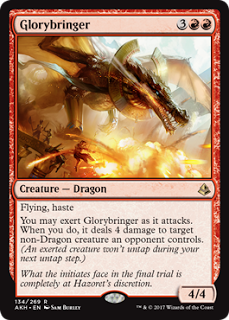
When I first saw this card, what popped into my head was that, back in the days of Thragtusk/Huntmaster Jund, you had to choose between Thragtusk or Thundermaw Hellkite (or you could play a million 5 drops, which seemed bad). What made Thragtusk the (clear) choice was that it was better value, even if it didn't clock the opponent as fast. The difference that Glorybringer has over Thundermaw Hellkite and Stormbreath Dragon is that you get that value out of it despite being the big hasty flying closer card. Even shooting a 2/2 or something then getting hit with a removal spell the next turn is a two-for-one, and when Glorybringer one-two punches a creature and a Planeswalker in one hit, then still demands a removal spell? That's what the Jund Life is all about.


So this thing was supposed to be a big deal, right? Yet we only saw two copies of it in the Top 8: two copies in one of the five Mardu decks to make the playoff rounds. I was surprised. This card seems perfect in the format. I'm not selling my Glorybringer stock yet.


While it fights for slots against Archangel Avacyn, it also SMOKES Gideon, which is public enemy number one. I think that this thing will either see more play in Mardu, or another good list with it will pop up (foreshadowing) and Mardu will have to adapt. If there are five Mardu decks in the top 8 of the Open the week before, you can bet I'm gonna roll with the G-Bringer one way or another.


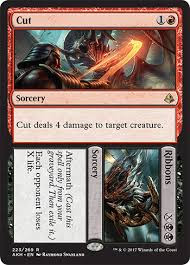
This card was very impressive in the games I watched it in. It played a huge role each time it was cast, which wasn't even that often considering the low numbers it was played this weekend. The removal is pretty good, about as good as we can ask for for the mana. But while you might just get a even-mana one for one on the front side, having Ribbons in your graveyard completely changes the play patterns of each player. You never even have to cast Ribbons to make its effect felt because your opponent has to worry about their life total the whole game. It makes late game land topdecks much better since you just keep creeping and creeping towards their life total.


We run into a problem here with Cut to Ribbons and Glorybringer, though. How many creatures do we need to hit with four damage at sorcery speed? In Mardu, there's Toolcraft Exemplar, maybe a couple Thalias, Avacyns that have stuck around, bad trades with Gideon tokens, Scrapheap Scrounger, and Thraben Inspectors, maybe a Heart of Kiran that already blocked and killed something of yours? Grasp of Darkness seems like the much better removal spell if we're calling the Ribbons half "just gravy", since it isn't just gravy if we could be playing something better on the front side. But it isn't just gravy, it's actually huge, and its cost, while existent, is small. I don't think it's at its best in the mirror, and maybe that will be it's downfall, but Cut to Ribbons is great against all forms of Winding Constrictors and other creatures that I think it'll be a mainstay in decks like this. When your deck is aggressive enough to take advantage of Ribbons, Cut looks a lot more attractive.


So what does this mean for Jund? Well, I've got two answers:


Beat 'em


4 Glint-Sleeve Siphoner
4 Glorybringer
2 Longtusk Cub
4 Tireless Tracker
4 Walking Ballista
4 Winding Constrictor
3 Fatal Push
2 Grasp of Darkness
3 Never to Return
3 Cut to Ribbons
2 Painful Truths
4 Attune with Aether


4 Aether Hub
4 Blooming Marsh
4 Canyon Slough
1 Cinder Glade
1 Forest
2 Mountain
2 Swamp
3 Sheltered Thicket


Sideboard: A smattering of discard, planeswalkers, and sweepers.


B/G Constrictor was pretty much the third deck in a two-deck format for the last few months. With one of those decks banned, I thought it might be a good time to bring it back, but this time with some Amonkhet upgrades and a little color shifting. However, are they really upgrades?


We've cut Rishkar and Nissa, Voice of Zendikar for extra Tireless Trackers and more removal. What do Cut to Ribbons and Tireless Tracker have in common that Rishkar and Nissa don't?


*Point to Bill James protege* "They're good on their own?"


Right, and we've cut Verdurous Gearhulk for Glorybringer. Why have Glorybringer in a Winding Constrictor deck?


"It's good on its own."


So it keeps its nut draw Constrictor + Whatever draws, but doesn't run as much of the stuff that's only good with Constrictor out. The mana is pretty solid, since we will likely have a bunch of energy to use in our Aether Hubs, much like Spire of Industry happens to be great with Mardu's artifacts. Why is this important? Because we are only able to run four Constrictors, and because our opponents are allowed to play removal spells. However, that begs the question, should we even run Constrictor and lean on the synergies it creates, because we could be playing a completely different creature/mana suite. That may be the case, but Gifted Aetherborn and Sylvan Advocate aren't exactly tearing it up right now. There are a lot of different threats that we could be playing, but in the end I think that Aether Hub and Attune are the best way to build a 3 color mana base anyways, so Glint-Sleeve and Longtusk Cubs look a little bit better. I could be wrong.


The list is very rough, I wouldn't advise wandering into a league with it and expecting good results right off, but I think it has potential. They're all good cards, Brent, and you do have some draws that are just really powerful and demand an answer or they get out of hand. But in the end, if it's just a Gideon-less version of Mardu, we might be better off looking elsewhere.


Join 'em


If you want to know about the Jund deck that I ran during the Khans of Tarkir standard, you're not going to find it, because I was Rhino-ing people like the rest of y'all. In this blog, we aren't going to strictly stick to Red Black and Green, because to me, Jund is more a strategy than a color identity. See, tying yourself to colors isn't really going to be a good idea. Power levels of colors ebb and flow, but strategies withing the rules of the game are usually pretty consistent. We want the ability to switch roles, present powerful threats, create long-term advantage, stop the opponent, and prevent the opponent from stopping us. These are not color-specific traits, they are just good, solid ways to win games of Magic.


We aren't building decks, we're building wins.


I don't know if that phrase actually applies, but it felt so good to write. Anyways, if Gideon-braid Elf is able to play offense and defense, be a powerful threat, create long-term advantage, stop our opponent (by attacking their planeswalkers and pressuring their life total) and is hard to kill, it might be the most Jund thing to do, and we should get on board. Chapin (I think) said that you never want to be a worse something else, but Chapin also probably already owned Gideons on Modo.


I'm going to try and make a post every Sunday night, hopefully with some Magic Online testing, or video coverage, or tournament experience to talk about each time, be it Modern or Standard or Legacy. And each time, we'll keep digging in to discover a deeper meaning of Jund and of Magic as a whole. Maybe that's a stretch, but we'll see.


Thanks for reading! You can hit me up at @griffinzoth on twitter.