Sunday, January 17, 2021

Every Damn Thing But The Jailhouse Keys: Five Drops

At five mana, we find ourselves some cards that are extremely powerful. Things that, when they're in your deck, can tangle with Uro, Nissa, and Teferi on raw power. As with all cards, they look amazing when they're on the battlefield, but not amazing when they're in your hand and you don't have the mana to cast them, or when the ability they have to turn the game around is dwindling.

Each of these cards listed is super duper strong, and each with their own set of pros and cons, which is kind of the problem in my eyes. If you're going to be paying this much mana on something, it's gotta be the right one every time, and as it stands, none of the cards are lights out against the whole format. Some of them are lights out against some of the decks, but beatable against others.

Gargaroth is usually just going to end the game when you untap with it. That seems like a quality that you'd want in a card, but for this mana cost, the downside if they do have the answer becomes huge. Unlike something like Chevill that is high floor high ceiling, Gargaroth is super low floor and super high ceiling, just because of the mana investment needed to play the two cards.

I think that there are times when Gargaroth could be better, but right now lots of decks are playing black removal spells or counterspells. When red removal is the most played way to deal with creatures, Gargaroth looks much better. If you think it will live, and you think you will live long enough to cast it, there's nothing better, but it doesn't seem like those two things are happening right now.

Glorybringer is similar to Gargaroth in that it is extremely good against an aggressive deck. If they don't have black removal or counterspells, then you're going to be getting some value out of it. It acts a little like a planeswalker, whever every other turn it casts a 4 damage Searing Blaze, but you can also just turn on the jets and try to close a game quickly.

I think of Glorybringer as an anti-creature huge-drop like Gargaroth but slightly worse against creatures and slightly better against UW Control. If your list has a more aggressive slant to it and the 4/4 haste can finish off an opponent from time to time, Glorybringer gets a little better. Out of all the five drops available to us though, I would say Glorybringer is among the worst options against Sultai, which certainly is public enemy number one. It matches up poorly against Uro, Krasis, Nissa, and Doom Whisperer, it's hard to attack Sultai's life total, and they have answers for it like Maelstrom Pulse and Aether Gust if needed. That said, if the format moves to a place of creature decks where Glorybringer shines, like Gruul, and planeswalker heavy control decks, like Grixis, then Glorybringer starts to look good.

Out of these first three cards on this list, Thragtusk is the one I like the best for a wide open format. It's got immediate value, it's got stats big enough to attack down a Teferi, and it's good against removal, instead of being bad against removal. It's a big enough roadblock against aggro decks that you can usually turn the corner with it.

However, being a Jack of all trades means you're an Ace against nothing, and if we're spending five mana for something big, it needs to have a lot of power. Thragtusk is most playable in a diverse metagame like we're in now, but that a five mana spell isn't too expensive for the speed of the format.

The Eldest Reborn is my favorite five drop if you expect to be playing fair magic and want some value. This thing gives a ton of value and is pretty hard to get off the board. It's one of the best things to be doing against midrange mirrors and control decks, but it lacks so much against aggro decks. Most of the aggro decks in the format go wide, so your opponent might be losing a Soul Warden, a Cauldron Familiar, or a Llanowar Elf.

Eldest Reborn, in my eyes, is more of a maindeckable version of Angrath, but I don't think that's something we're looking for.
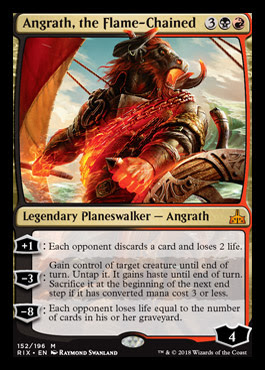
Angrath shines against Uro, which as you could imagine is very valuable in this format, but it lines up nicely against other things out of that deck, like Nissa and Hydroid Krasis. It also can pretty nicely square off against Teferi out of U/W Control decks. It disrupts the opponent's hand and makes counterspells pretty weak, it pressures opposing planeswalkers by stealing their stuff and then attacking them with their own creatures. It also has a little bit of inevitability attached, since it Shocks them every turn.

Angrath represents a card advantage engine that also can help itself gain traction, but as long as it resolves, is never able to be answered on a one for one basis. The -3 is a tempo play that can completely change the focus of a game, from both players amassing board presence to your opponent being on the back foot immediately, and having to deal with an engine/clock planeswalker. Similarly to most of these cards, untapping with it in play gives you a huge likelihood to win the game.

I usually play Angrath in the sideboard, and the reason is that, the matchups where it's at its best are matchups where you can expect to get to your fifth turn. At this mana cost, you can play cards like this where they're included to fight a specific card (Uro) but are just strong enough cards to come in for a lot of matchups. Plenty of times when you're playing against another midrange brew, what you're really looking for is a disruptive value threat to try and go a little bigger than the opponent, so Angrath shines there as well.

~

These are the five drops that I've considered playing in the last few months here, but there are others that I've tried out. Siege Gang Commander, Biogenic Ooze, both 5 mana Viviens, and Doom Whisperer come to mind, but they don't really seem to have the huge power swings that the cards I've listed here have. I also talked a bit about Battle Mammoth in an earlier post, and I think that one is a contender if, like always, a five mana spell is something we want to be doing. As for going further up the mana curve, Casualties of War is my favorite supermassive value card, but Garruk Cursed Hunstman is a pretty unbeatable force if you can get it into play. I don't think the Historic format lends itself to doing stuff like that but you kind of never know. If Uro gets banned ever, it will definitely shake up a lot of our preconceived notions about card assessment, and I'll probably have to rewrite this whole series. Anyways, I think I'll do two more of these, one on removal spells and one on sideboard cards. Thanks for reading.

Tuesday, January 12, 2021

Not A Chill To The Winter But A Nip To The Air

Taking a break from the Jailhouse series today to check in on Kaldheim spoilers. I've already talked about Sarulf here if you want to check that out, but we've seen a lot of new cards since then. There's some stuff that's between interesting and good for us, and there's some stuff that's between interesting and format defining against us. 

FYI, I'm gonna talk about some cards that are leaked and not official spoilers. I'll let you know when that's going to start and we'll cover the non-leak cards first.

Let's start off with this thing.

Metagames get into a weird place when there are forces that push players to play one-color decks. If you were playing during the Return to Ravnica/Theros metagame, you probably remember Mono Black Devotion, Mono Blue Devotion, Mono Green Devotion, Mono Red Devotion, and Mono White Devotion. The devotion mechanic made you really want to play a single color to maximize its effect. That was one of the forces there, but the other was Mutavault. It was a card so strong that you'd rather play fewer colors and therefore weaker spells in order to cut dual lands from your deck and not get color-screwed. A hand of a bunch of black spells, swamps, and a Mutavault was usually better than a hand of multi-colored spells, dual lands, and no Mutavault.

This has a pretty significant homogenizing effect on deckbuilding. When you are strapped to playing one color, then you usually just play all the best cards in that color. There was a little bit of room to customize, but if your opponent played a swamp on turn one, you could usually guess about 55 cards that were in their deck. Customizing and tinkering your deck over time was reduced to which C- removal spells you wanted in your couple of flex slots. And the thing is, what can you realistically do to change it? If you try to come up with some neat new deck that attacked the mono-color decks, you were either just playing a mono-color deck with worse cards, or you were playing multiple colors and therefore not being able to play Mutavault.

To be fair, I honestly liked this format a lot. I was able to do a little bit of deck tuning and customization within the restrictions of the format, and the decks themselves were not the most egregious things to have to play against. Lots of players complained about Pack Rat and Thoughtseize, but players will always complain about whatever they lose to. However, a couple of 2019-2020 power-level printings and this format would have been awful. Imagine if there were only five decks you could play, and they were all one color, but one deck had a card as strong as Omnath or Oko or Uro.

Snow is a mechanic that's similar to Devotion and Mutavault because it draws you into playing just one color. We haven't seen all of the payoffs that we're going to get for Snow decks, but with Faceless Haven in the deck, it doesn't have to be much. It's not as good a card as Mutavault, but it does something that no other deck really can do to this level. The vigilance is very strong and it hits really hard.

I think that this card could make mono-blue tempo decks and mono-black aggro decks really good in this format. Those two decks aren't too far off of being solid metagame contenders on their own, and now they get to have something that few other decks will get to have, to go along with how consistent their game plan and mana bases are. I also think that we'll have to take a hard look at Mono-Black midrange. When you can cut color consistency issues out of your deck but not go down on power, it's very enticing. Either way, I also think this might just turn into a metagame staple, and something we have in the back of our minds when we build decks.


When you compare this card to other Simic Mythics like Oko, Uro, and Hydroid Krasis, it definitely seems worse. But how do you beat it? My guess is that Sultai won't play this card because the card quality of that deck is so high already, but if they do then it's certainly going to be trouble.


I also just wanted to mention this card because I don't know if there will be a cycle of them or if any of the ones in our colors will be good, but I'm always up for some value lands. Also, I knew Gavony Township, and this sir, is no Gavony Township.


Great numbers, flying and lifelink go very well together, but we just barely got Nighthawk Scavenger given to us and turned it down. This card starts to look good when our opponents have not just Planeswalkers, but Planeswalkers that have creature removal abilities. Eradicator Valkyrie is awful against Nissa and Narset, but would be good in a format where Chandra was popular, or Teferi Time Raveler was legal.


So first of all, it's totes adorbs, right? My wife and I are currently long-term cat sitting for our friend Kyler (who is rats_relyk on twitch and has a really cool stream) and their two cats look just like these two. Check this out:


So about the playability, it's honestly not that far off. You get two 2/2 bodies and a little extra value, which depending on what that extra value is, we start getting into Huntmaster of the Fells territory. But we don't really have anything (other than the Chariot itself, ostensibly) that makes tokens. We also don't play a ton of creatures that have four power, so the vehicle might just sit around and not do much after the cats are gone. If we could depend on giving our creatures pseudo-haste with the vehicle or creating some tokens, I'd be more interested. It's definitely something to keep an eye on, because it lines up really well against Gruul, and there are some token generators and four-power creatures that aren't that far off from being playable. Maybe Thrash/Threat or Sarkhan the Masterless?


I want to compare this with Eldest Reborn, but it's not really a card advantage engine like that. It's closer to Vraska Golgari Queen, except the effects that you get after the initial removal spell ability are worse. In my mind it's more like Maelstrom Pulse than anything, and it doesn't give the upside of getting some free wins when your opponents draw multiples of their creatures.


It takes a lot for me to completely dismiss a card as versatile as a dual-face modal card like this, but I don't think we want to be doing either half, and both halves cost a lot of mana.


This one was just spoiled and I haven't quite wrapped my head around it yet. I don't think it's going to work in a deck without good graveyard synergies, but a three-mana 6/6 is just so big. It doesn't really have to be in play for very long to have a pretty important effect against Gruul, you cast it, you threaten to block for a couple turns, then you cash it in when you run out of food. Unlike something like Rotting Regisaur, you can use the back half when the body isn't good, which also seems like it's a pretty solid card in the right matchup. I'm skeptical but I also think that there's so many options with it that I wouldn't be surprised if it found a place.


Okay, so this one I'm bullish on. First of all, it's hard to judge how good Valki is because it has a pretty amazing backup plan if you draw it in the late game. These dual faced cards are so versatile. Being a two-drop creature is supposed to be a big cost, since later on in the game you don't want to be drawing Goblin Piker. But Valki gets around this pretty well.

Second, this is as high-floor high-ceiling as it gets. If you trade your two drop with a Fatal Push, okay fine. But if they don't have it, or you Thoughtseize it, or they used it on your Scavenging Ooze, all of a sudden we are stealing their Uro and getting Uro triggers on turn three. Against Gruul it protects itself by stealing Bonecrusher Giant if need be, and saves you damage by taking their haste creature, trading in combat, then they can only play their haste creature post-combat. If they Stomp it (or Swift End it) in response to the trigger, they lose a different creature forever. Also lol if they kept their hand based on playing Mammoths as lands. Add to that it's also an out to Muxus and Goblins don't have a ton of ability to get it off the table, you get information, it's great against Kroxa, it turns itself into a mana sink if you take something big. This thing does a lot of stuff for a card that's such low investment.

Third, if you've played Inscription of Ruin before, you know that the ability to have a useful cheap play that can go toe-to-toe against our opponent's expensive stuff late really turns matchups around. Plenty of times I've been dead to rights against Sultai or a control deck and cast a full blast Inscription and won the game. All that from a Mind Rot/Smother flex slot card. Tibalt is also really strong against Uro, which makes it extra valuable as an expensive card. We're not supposed to have this much late game power if we're also playing cheap cards and keeping our curve low.

The last thing I want to say about Valki is that in the Jund deck as we have it built now, Valki definitely is easy to make space for. I've been slamming my head against the wall trying to find the right two-drops to go alongside Scavenging Ooze and Chevill, and Valki is certainly high on power level and can do its own thing. We have a deck that both wants early plays to keep up against aggro decks and wants to play big spells to turn the corner. I like it a lot.


--Leaks--


Some folks in a Historic Midrange discord I'm in have been having good experiences with Shaper's Sanctuary out of the sideboard lately. It seems like you need a lot to go right, like they have targeted removal spells, you have a lot of creatures, and the strength of your creatures necessitates them killing them instead of just casting Uros and Nissas or Wraths and Sharks. If those things are in play, though, it's pretty amazing to be able to draw a bunch of cards for one mana, and it's even better in multiples. Battle Mammoth gives us that same effect but without costing a card, and it has huge stats.

I haven't spoken about Foretell because it's not on any of the stuff that seems interesting to me, but I think that it's very useful. Build your deck however you want, there will still be hands you draw where you're not really doing anything useful on turn two. When that's the case, you can put that mana to good use and get Mammoth out a turn early. That might not seem that useful, but Mammoth represents a huge roadblock for Gruul and other aggro decks, so getting something like this out a turn early represents saving a lot of damage.

As I'll likely talk about in the next blog post, I'm not sure if a five mana or more threat has a place in the deck. There are a lot of good options between Elder Gargaroth, Thragtusk, Glorybringer, Angrath the Flame Chained, and more, each with their own set of pros and cons. But Battle Mammoth gives you the best option of all of them, which is of course, to not be five mana. Lots of rate, lots of upside, lots of flexibility, but it still just might be too much mana.


This card impressed me right up until I saw Valki, but I think it might have potential. In the Robber of the Rich/Burning Tree Emissary format, 2/2 First Strike is solid enough that if you have some late game value it might be worth it. Again, if it eats a Fatal Push, then it's okay. It's a low investment card that can get out of hand if not dealt with, fills the curve, and pressures planeswalkers and life totals. Getting a single 5/5 out of the deal is great, but it has potential for a lot more. There's a lot of play here that I think is worth trying out. Even if you get a dragon one out of every ten times you cast it, the threat is there and your opponent really can't afford letting you untap with this.

~

Spoilers keep rolling in, so I'll keep up with any cool stuff I see. There's usually some kind of Doom Blade/Hero's Downfall type thing to check out that we're missing at the moment, so I expect something like that to show up. I really like the look of the set. Dual faced cards and Foretell cards are the type of thing that give players lots of options, which is what we're looking for in midrange decks. Let me know your opinions in the comments, and thanks for reading.

Saturday, January 9, 2021

Every Damn Thing But The Jailhouse Keys: Four Drops

We're getting into territory here that's somewhere between top-end and middle of the road, depending on the speed of the format. In something like Modern, we can afford something like Bloodbraid Elf and Huntmaster of the Fells, but that's about as high as we can go up the mana curve for a deck like this. In Standard, Huntmaster and Bloodbraid were the cheap-to-middle of the curve threats. Same deck philosophy, same cards, different roles. That has a lot to do with the speed of the format, but it also has to do with the narrow margins that games are decided on when the cards are cheap and efficient. That same Huntmaster that takes over games in Modern looked pretty helpless in Standard when the opponent was casting Sphinx's Revelations and Angel of Serenitys.

Historic is in a speed and power level area in between Modern and Standard and maybe a little slower than Pioneer. You wouldn't quite say that four mana is expensive, but you really can't go much higher. Not only are a lot of games over quickly, but the power discrepancy between something like Chandra Torch of Defiance and Glorybringer isn't as pronounced, because both cards are pretty unbeatable if they stick. So, what we're looking for is something that can stabilize a board and then turn the corner. It's a tough ask, but at four mana, there are some cards that are up to the task.


Speaking of, Chandra just seems to be the best card here. She nukes a creature the turn she comes into play, which is pretty similar to every other Planeswalker. The mana ability is useful from time to time, and the +1 is a little worse than drawing a card but applies pressure, which is what we're looking for.

Also unlike most Planeswalkers available to us, she has the ability to actually win the game on her own, or pretty close to it, with her ultimate, and it's pretty attainable. This facet of Chandra is part of why Teferi, Hero of Dominaria and Jace the Mind Sculptor were so good. As long as you can keep pace with what your opponent is doing while Chandra is on the table, you don't really need to worry about pressuring the opponent, she can handle that herself.

Chandra, more than most cards we can play here, does something special which is that she helps you dig through your deck. In a format like Historic where we have some lights-out sideboard cards, the ability to have extra shots to find those cards will win a lot of games. Grafdigger's Cage and By Force come to mind, but you can also play stuff like Sporeweb Weaver or Witch's Vengeance in your sideboard if you anticipate those decks. As decks get more singularly-focused and these knockout sideboard cards look a lot better, so does the ability to find those knockout cards. When Kaladesh Remastered was released I was worried about replacing Liliana, Waker of the Dead with her because I needed that ability to go after the opponent's hand. Instead, Chandra turns out to be great at that effect because your deck has lots of that effect and she draws you cards.

Chandra gets hampered by the Legend rule pretty badly, since her +1 misses if she hits another copy of herself. That said, she also gets around the Legend rule by killing the opponent. I think playing two copies is the right number at the moment.


Liliana is a great card. She's a lot like Chandra in that she can come down and kill a creature, then get to work on your opponent's resources. She's a good topdeck because, like Chandra, she can turn her +1 ability into a clock when it otherwise wouldn't be useful.

What she lacks from Chandra is that she's graveyard dependent, meaning that her -3 and -7 abilities aren't going to be as useful in a format with Scavenging Ooze. Not only does her -3 do next to nothing against an Ooze, the -7 isn't great in conjunction with our own Oozes.

What I will say about Liliana, though, is that she can do a lot of the same things as Chandra while not being named Chandra Torch of Defiance, so she's a totally fine choice if you want more Planeswalkers but don't want to go higher on Chandra. Note also that Liliana's Legend Rule problem isn't that bad, since you can just discard excess copies of herself. I don't think there's too many cases where she's going to be better than Chandra, except in a case where you want to cut double-red costing cards from the deck.


Vraska is of course in the same league as Chandra and Liliana but has some significant differences. One is that the +2 ability is pretty useless for us, we don't have very much graveyard synergy and we want to keep our lands if possible. However, the ultimate is pretty strong here and she gets there pretty quick since she climbs by 2 loyalty a turn.

Vraska's biggest upside is when you start to see opponents playing things like Search for Azcanta and Narset. All the Planeswalkers can pick off creatures and get a little value while they climb to ultimate, but Vraska adds in a little bit of versatility to fight against some stuff that we normally have difficulty dealing with. She also gets back up to three loyalty after just one turn if you use her -3, ready to Abrupt Decay another permanent.

If I had to rank them, at the moment I like Chandra, then Vraska, then Liliana.


A different route, but Questing Beast can get some work done for us. The thing here though is that for Questing Beast to be at its actual best, we want to pressure life totals, which we don't really do that well most of the time. You can tune the deck to be more proactive if you want to, sure. I really like Questing Beast when it's pressuring their life total and doing something else, which is to say blocking, killing planeswalkers, and sometimes even countering Fog effects. When the format had lots of Teferi Time Raveler and Haze of Pollen, Q Beast was great.

Anyways, this all is on a package that just gets hit by Doom Blade effects, unlike Planeswalkers. And also unlike Planeswalkers, if we hit them from 20 down to 8 with it and then they find their removal spell, then the game just continues as normal. With Planeswalkers, you've usually gained a bit of value off of them just being around and trying to get to their ultimate.

Questing Beast is pretty consistent, though. It's never going to be a terrible card to cast on turn four and never a terrible topdeck. I don't hate it, and again, if people start playing more decks with Planeswalkers that this thing can gobble up, give it a shot.


When Rekindling Phoenix was spoiled in January of 2018, I wrote this:

"This card is really cool, and I think it's really good, but I really can't imagine it's going to see play until Chandra rotates out of the format. Watch out for this one being really good in the future. It does a lot of cool things that a lot of decks are looking for, but Chandra just does better."

Phoenix is a fantastic card, and it stabilizes a board and turns the corner like we want, but its inclusion in the deck at this point is based pretty much solely on Chandra. There will be times where Rekindling Phoenix is great, where blocking and being good against removal are important in the format. Phoenix's problem is that in that specific universe, Chandra is really good too, and she'll be good all the other times too.

I also didn't mention this with Questing Beast, but as of right now, in the back of our minds we should be thinking about Uro with just about every card that we put in the deck. Planeswalkers at least can try to kill Uro and keep it off the table or dig and try to find Scavenging Ooze. Phoenix and Questing Beast kind of just lose to it, so that's another detractor.


I actually like this card quite a bit. I mentioned Huntmaster of the Fells earlier in this post but Polukranos does a pretty good Olivia Voldaren impression. Unlike Olivia, the turn Polukranos comes down it's already big enough to tangle, and you don't care that much of it dies.

Polukranos's downsides are kind of the same as Questing Beast and Rekindling Phoenix's except that it hits in really big chunks. Six power is a lot, and an Escaped Polukranos may as well be Phage the Untouchable, which means that it has a ton of ammo to shoot down opposing blockers. Six other cards in the graveyard is a long time in this deck, since we don't play anything to really facilitate it, but in matchups where you're getting to six mana, you're likely going to get to six cards as well.

Additionally, Questing Beast is the right recipe of useful mana sink and body that's good enough if we don't have the time to use it. It costs mana, but Polukranos can do something useful while it's in play, unlike Questing Beast who can only attack for four and then pass the ball back to Jimmy.

I like playing a Polukranos from time to time, when I expect to not get tempo'd out by playing it and when my opponent is likely to have small creatures. It's versatile, consistent, easy to cast, and is high-rate.
~

Of course, there are a lot of cards that are perfectly reasonable to play at any price point in these colors. These are the ones I've found to be the best, but if you think I've missed one, or have a different opinion, let me know in the comments. Thanks for reading.

Saturday, January 2, 2021

Every Damn Thing But The Jailhouse Keys - Three Drops

Three drop creatures in this deck are in a weird place. They aren't cheap enough to create an early advantage, but they're also not powerful enough to stabilize a board. That's not to say that they can't exist, but more that they don't at the moment. A printing like Kitchen Finks or Courser of Kruphix would slot nicely into this deck, but alas. For now, what we can get out of our three drop creatures is versatility.

Radha is very matchup dependent. The problem with her is that the matchups where she excels are the ones where removing a three mana 3/3 isn't a huge problem for the opponent. That said, she's good with Kazandu Mammoth et al, and she really only needs to hit one land off the top to be worth it. If you're the aggressor in the matchup, then she's definitely a must-deal-with threat, which is kind of all we can ask for. But again, the awkwardness of the three mana slot is that it's not always going get you value if they have the answer and also not cheap enough to be a good play if it trades one for one. She's also in this awkward place metagame-wise where she's a little more matchup-dependent than you'd like for a maindeck card but also not quite focused enough to be a sideboard card.

Where I've landed with Radha is that if you're gunning for Sultai, conrol, and midrange matchups, a one-of Radha is just fine. If you're spending more of you time on the back foot and facing Gruul, Goblins, and stuff like that, then Radha's maybe not what you're looking for.

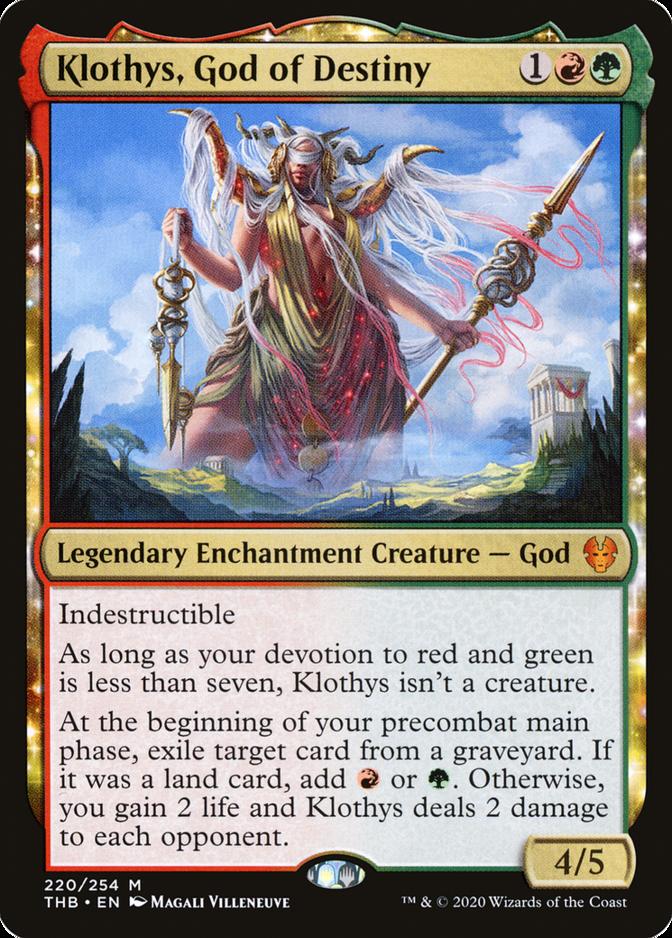
Klothys is in a similar spot as Radha, in that having a one-of copy in your list is fine if the metagame calls for it, but it's not quite a focused enough card to be a sideboard card. That said, Klothys is less matchup dependent than Radha, and while it doesn't quite take over the game if left unchecked like Radha can, it provides a unique Uro-fighting ability, is hard to get off the table, and gives you inevitability against control decks. It seems that either gaining 2 life a turn, dealing 2 damage a turn, or exiling cards from the graveyard will be good against almost any opponent. That said, I would never go higher than one copy in the main deck because Klothys is uniquely hampered by the legend rule.

Jadelight Ranger might be the strongest three drop creature available to us, but the reason I don't play it is because of its mana cost. 1GG isn't impossible to cast or anything, but what Jadelight provides is an ability to make land drops and smooth your draws. Ideally our mana enablers are easy to cast, but adding Jadelight to the deck would decrease our consistency overall instead of increasing it. Jund Triome when????

I was high on this card when it was released, but quickly learned that it's not quite what we're looking for. The lesson for Nighthawk Scavenger is that, at least at the moment, you can't just pay three mana for power and toughness. Nighthawk is too easy to remove and also not powerful enough to stop any of the things our opponents are going to be doing.

Having said that, Nighthawk Scavenger might have a place at some point, because the numbers on the card are just so good. In Modern we play Tarmogoyf not because it disrupts the opponent, but because it kills them. If we get to the point where we're looking for threats just to attack people with, then Nighthawk is at the top of the list.

Mammoth has been fantastic. At first glance it doesn't seem like a card advantage card, but you've gotta remember, mulliganning is card disadvantage. Mammoth gives you more keepable hands, which is one of the advantages a deck like this is looking for. Unlike some of the other cards in this category, Mammoth doesn't just attack and block, but it does attack and block perfectly well for the flexibility it gives you. Five damage can kill in four hits, or it can kill a Teferi in one, so it's pretty important they get rid of this thing when it's on the table. Like I've been saying, the three drops in this format aren't going to blow you away with their power, and they're not coming out of the gates super fast, but what they can provide is some flexibility. Mammoth does this very well.

I wasn't writing in the blog at the time, but before the companion nerf, this was a Lurrus deck and it was fantastic. As for nowadays, Lurrus is still just a fine card to have in your deck. 3/2 Lifelink is honestly pretty good against a large portion of the field, and when your two-drops you can rebuy are things like Scavenging Ooze and Chevill, there's a ton of late game value and toolbox-ish gameplay available.

Lurrus runs into a lot of the problems that Legendary creatures have, where you can't really play too many of them. That would be fine, except that to get the most out of Lurrus, we'd like to be playing some specific things that are pretty subpar when you don't draw Lurrus. Dead Weight comes to mind, but you also want to have a lot of two drop creatures, more than you would probably play without Lurrus. Unlike Inscription of Ruin, where if you don't happen to have a creature in your graveyard you can do something else with it, Lurrus really wants to be reanimating things.

I like that Lurrus is a good three drop creature but also a good five drop creature. You have a lot of play with it and it's all powerful stuff that it's doing. But the downsides are pretty numerous, like how we open ourselves up to graveyard hate, how poorly it plays with Grafdigger's Cage, and how the legend rule can get us if we try to play too many copies. In the end, Lurrus is the perfect example of something I mentioned a while ago in a blog post (maybe it was a video? I forget). To get the most out of our cards, while also playing the midrange game of disruption, consistency, and being difficult to attack, start looking not only at tuning one deck but coming up with packages to slot in and out of the decks based on what the metagame is calling for. Lurrus doesn't have to have your whole deck built around it, but a 6-card "Lurrus Package" that includes two Lurrus, one Dead Weight, a Kroxa, and a couple Merfolk Branchwalkers might be a good trick to have practice with when you think the time is right.

Here is a pretty cool Lurrus deck that we can work from.

Deathgorge Scavenger is a little bit like Klothys in how flexible it is, but unlike Klothys the power level of this card is just a little too low. As I write this I have been playing one copy to fight Uro decks alongside the normal four Ooze and one Klothys, and it's been solid enough to keep in. While it does just about everything we want, it's probably just one mana too expensive, seeing how unlike Klothys, if it's really hampering the opponent's game plan then they can just kill it. Definitely a high-floor low-ceiling card.

Bonecrusher is a phenomenal card rate-wise and flexibility-wise, and it takes just about no work to make it good in the deck. Its only real problem is that the metagame right now is just not suited for it at all. Gruul's creatures are often too big for the Stomp half, and the other aggro decks of the format are running stuff like Witch's Oven, Village Rites, Alseid of Life's Bounty, and Skirk Prospector. The control decks can answer the 4/3 with stuff like Baffling End and Glass Casket without even taking damage from its ability, and it trades with Nissa Elementals.

Having said all of that, you still really can't go wrong by playing Bonecrusher Giant. Even if the deck isn't really focused too much on pressuring the opponent's life total, Bonecrusher can just end the game by itself pretty fast if left unchecked. Similarly to Kazandu Mammoth, if you're looking for a good creature to just attack and block with, choose the ones that give you some additional flexibility and consistency in your draws. This deck isn't blowing anyone's doors off in the power level end of things, so consistency and flexibility is where we make up ground.

~

As ever, the next set coming out in a few weeks here will likely change things up, but I'm especially excited about Sarulf. I think it will add an important dimension to this deck and we'll have to revisit some of these things. Let me know if you think I missed anything or to give your own opinions. Thanks for reading.

Monday, December 28, 2020

Every Damn Thing But The Jailhouse Keys - Two Drop Creatures

 Let's dive in.

Chevill is beyond bonkers. I think it's a testament to how absurd the power level of printings have been in the last two years that Chevill isn't a staple of at least Pioneer, nevermind Historic and Standard. A card like this in the past that was a card advantage engine stapled onto a mana-cost worthy body would normally lose you life. Think Dark Confidant, Glint-Sleeve Siphoner, or Midnight Reaper. Instead, Chevill draws you cards and plays defense. That is the recipe that we want in our best cards, the ability to be proactive and protect you at the same time. Some of the best creatures in Magic's history fit this description: Tarmogoyf, Stoneforge Mystic, Scavenging Ooze, Thing in the Ice, Kitchen Finks, Courser of Kruphix.

Chevill doesn't really force you to to do anything special to accomodate him, but he certainly makes your removal spells better. We aren't playing Bloodchief's Thirst and Maelstrom Pulse and Chandra because of Chevill, we play them to kill our opponent's stuff, but Chevill turns your necessities into an advantage. He's perfect for this kind of deck.

Chevill also neatly dodges the legend rule. Opponents are often willing to trade a creature in combat just to get him off the table, which frees up the second copy in your hand. If your worst case scenario is just Doom Blade, then I like where we're at. Also, at first glance, Chevill looks like a liability against control decks, but in practice it's a huge plus to be able to recoup some of the inherent card disadvantage that comes with casting removal spells on planeswalkers. I play three Chevill normally, but in aggro-heavy metagames, don't be afraid to go to four if you anticipate needing to trade him off early.

Ooze is quite a bit different than Chevill, but accomplishes a lot of the same thing. It adds value to your removal spells, since you can eat their creatures for life and counters. Ooze also can act as your late game nail in the coffin card against aggro strategies, since with more mana at your disposal it turns into Pelakka Wurm pretty quickly.

Ooze also does this thing that's really special in Magic: it's a main-deckable hate card. Lots of decks have Uro or Cauldron Familiar, sure, and Ooze has some incidental value there, but Ooze makes your deck better by being a pretty dedicated hate card against graveyard decks while being in your starting 60. It's probably not as good as Leyline of the Void (although even that's up for debate, I've never attacked for nine with a Leyline of the Void), but it also doesn't take up space in your sideboard. It's also there for game one, so you have more chances to steal games by drawing your hate cards.

Ooze's only drawback in my mind is that I find myself boarding it out against decks without creatures. But again, Ooze's floor is really high, a grizzly bear that can pump itself every once in a while off your own dead creatures or can help keep Search for Azcanta or Torrential Gearhulk in check. I like playing four, and would not go below four as long as Uro is in the format.

Channeler is first up in a pretty long list of cheap creatures that I've been trying out (well, Knight of the Ebon Legion is kind of in this category, too). It has a lot of the things we look for in a threat for this deck: it's good early, it's good late, and it can help stop your opponent's game plan. It even has the ability to smooth out your draws if you're mana screwed or get rid of excess lands to find removal.

Channeler lives in this weird space where it's kind of a build-around card, but also the payoff is that you just get a 4/4 creature when you finally get there. Increasing your instant and sorcery count helps, but isn't super necessary, this deck doesn't care that much about getting the 4/4 turned on quickly, so long as it happens. But, Channeler does necessitate that we play more cards that are versatile and going to be useful as one of the two cards we hit off its ability. Kazandu Mammoth comes to mind as a card that's great here, but so is Maelstrom Pulse. The problem with this, though, is that if we're playing a bunch of versatile, slower cards to facilitate Channeler, then we have less desire to dig through our deck because the cards in our hand get the job done fine.

However, you can't say that Channeler is not good. I have had a lot of games where a Channeler came down early, perhaps did some blocking or chip damage, helped hit a critical removal spell or land drop, then turned the corner and hit for four a turn until they were dead. Not a lot of cards can compete with the likes of Chevill and Scavenging Ooze at checking all the boxes of proactive, defensive, and cheap, but Channeler does a great job.

To put this into perspective, I want this deck to have 10 to 13 cheap creatures, cheap being one or two mana. Channeler, in my mind, is at the top of the list behind Scavenging Ooze and Chevill. That said, if you're planning on playing this deck or a similar list, test for yourself and see what you like. I'll run through the rest of the contenders here and talk about their pros and cons, but really it might all come down to the metagame you predict and the way you like to play the deck.

Gifted Aetherborn is definitely a what-you-see-is-what-you-get kind of card. That said, whether it belongs in the deck is longer discussion. A few months ago, Historic was a much more aggressive format, with Gruul being the de facto top deck in the format and things like mono-red and others not far behind. In that moment, Aetherborn was excellent. The ability to gain a few incidental life points, trade with big creatures, and be a cheap and somewhat resilient threat goes a long way against the blunt-object decks of the format.

The format has shifted, however, and that's a big part of why Aetherborn isn't in the deck anymore. Even the current most popular aggro deck, Goblins, has a much easier time dealing with Aetherborn than Gruul, since it can just cast Muxus and attack for 40 or whatever. But the other part of the equation is that Aetherborn's mana cost is more prohibitive if we want to include things like Shatterskull Smashing and Kazandu Mammoth.

Merfolk Branchwalker was a mainstay of the deck for a long time, but some stronger stuff got printed and I haven't been back for a while. Still, this card does a lot of the things we want, and isn't as bad a late game card as you might expect, since there's a good enough chance that it draws you a free card. Nowadays, there's a good chance that free card will actually be a spell, like Kazandu Mammoth or Shatterskull Smashing. (Edit: This is wrong. Kazandu Mammoth et al don't count as lands for the Explore trigger.)

One thing that Merfolk Branchwalker does well is that it can often have good stats right out of the gate. It's not our plan, per se, to cast two mana 3/2s on turn two. If it was, I'd play Voltaic Brawler. However, a Branchwalker that doesn't flip over a land can put a lot more pressure on a control opponent than most other two drops, and that's the card at its worst. In order to get the most out of Branchwalker, you need any option that it gives you to be good, and I think our deck does that well. We're into drawing an extra card, and we're into attacking. We are into trading with a big creature and we're into drawing an extra card and trading with a small creature. All good stuff, but less raw power than most of the other two drops available.

Siphoner might be the best proactive card available for us, but it's also the worst defensive card. Not only do you lose life when you draw the card, but you have to attack in order to get it, and Siphoner doesn't block especially well.

You could say that the way to maximize Siphoner is to play with energy producers, which is true, but the other way to maximize Siphoner is to play with lots of cheap removal. I think the best shell of Siphoner adds in extra Fatal Push and possibly Harnessed Lightning, not only for its energy production but for being a good, cheap removal spell. That's because Siphoner is going to give you a raw volume of cards, so you can afford to have one of them be a dud in a matchup where removal isn't at a premium. Additionally, in order to have Siphoner work against creature decks, you need those creatures to be off the battlefield.

Siphoner runs into the same problem that Thoughtseize has, which is that while it's strong most of the time, there will be matchups where it's extremely bad and needs to be boarded out. With Thoughtseize in the deck, this means you're going to want to have eight cards to bring in against a dedicated burn deck, if you're playing four Siphoners.

To sum up this section, my rankings for best cheap threats are:

1. Scavenging Ooze

Also number 1. Chevill

3. Magmatic Channeler

4. Knight of the Ebon Legion

5. Glint-Sleeve Siphoner

6. Merfolk Branchwalker

7. Gifted Aetherborn

Take rankings like these with a grain of salt. Each of these cards is going to be better based on the build of your deck, the way that you play the deck, and the opponents you expect to face. I think they all have their merits and I wouldn't consider you wrong for playing any of them.

Kroxa, however, is a card that I don't like very much in this deck. I've touched on this before, but in order to maximize Kroxa, we need to really re-work a lot about the strategy of the deck, or have a very specific metagame that we expect to face.

Kroxa opens us up to graveyard hate that I don't want to get involved with. Uro is the number one card in the format right now, so people are prepared for this effect. If we're going to run the risk of being nailed by opposing Scavenging Oozes and Klothys, then we should make sure that we're getting the most out of Kroxa as we can. Run down this logic line long enough and you end up just building Rakdos Arcanist.

Additionally, Kroxa is slow. It doesn't effect the board at all, it gets rid of your opponent's worst card, if they even have any, and it's honestly kind of hard to cast from your hand, let alone when you escape it. Add to that how bad it is with Kazandu Mammoth in the deck, and I'm just kind of over it. It's splashy and wins big when it wins you the game, but I haven't missed it since I stopped playing it.

~

That's it for two-drop creatures for Jund Midrange in Historic. There are plenty more that I think are pretty good cards, but don't quite cut the mustard for slots in this deck. Let me know in the comments if there's any that you think I may have missed or to voice your opinion. Thanks for reading!

Saturday, December 26, 2020

Every Damn Thing But the Jailhouse Keys

When I was a kid I read the article My Fires by Zvi Mowshowitz. Actually it wasn't an article, it was an article series, all about one deck. What made it special was how in-depth Zvi went on every single card in his Fires deck, and also on cards that he didn't end up playing as well. Fires, like all Standard decks (or Type II as it was called back then), is a snapshot in time. Metagames ebb and flow, cards are printed and rotate out, but themes and strategies stay the same.

It's been just about a year since I really dug into playing Historic Jund. It's been a lot of grinding, bashing my head against the wall, but also analysis of cards and decks and trying to think deep about what I want to be doing and what space I want to be occupying. To wrap up 2020, I want to run through just about every card that's been in or out of the deck. I'll start with the one drops.


We got quite a gift with the Amonkhet Remastered set. Thoughtseize wasn't in either Amonkhet or Hour of Devastation, but it somehow got injected into Historic. Just wish we got the original art for it.

Anyways, Thoughtseize is so good that sometimes I think about the time before it became legal and have a hard time understanding how it all even worked. Thoughtseize is definitely a 4 of in any deck like this if they let you play it. That being said, in Modern we usually play 4 Inquisition of Kozilek and then some number between 1 and 4 of Thoughtseize. So if we ever get gifted Inquisition, we'll have to revisit.

Thoughtseize also makes our sideboard construction a little different. There are going to be decks we run into where it's important that we board out Thoughtseize, and so you need to have at least four cards in your board ready to go for that situation, and on top of that some more stuff for your maindeck cards that aren't optimal. Not a problem, just a something to think about. Anyways, yeah. Thoughtseize is great.

Also, if you only ever read one article about Magic in your life, it should be this one.


Sure, this is the quintessential sideboard card, but there honestly are some metagames where maindeck Duress can be good. When the second most popular deck in the format is 36 Goblins and 24 lands, then no, Duress isn't really maindeckable. But in metagames of the past I've had Duress in the main and didn't hate it.

As far as its sideboard utility, before Thoughtseize was legal I just liked jamming four copies in the board, but usually I've been down to just two. You can definitely draw too many copies of Duress effects, plus it's only as good as the threats that you're able get to stick with it. Lately I've been on two copies of Duress and three copies of good Planeswalker-ish threats to sneak in, like Phyrexian Arena and Angrath.


I'm currently not playing Fatal Push, but that has more to do with the power of Uro than it does the weakness of Fatal Push. We don't have a lot of ways to turn on Revolt in the Historic format at the moment, and surprisingly we have a newly printed card that does a really good Fatal Push impression while being more versatile in the late game. That said, it's Fatal Push, it's an exceptionally efficient removal spell and I think we can expect some future where Fatal Push becomes a mainstay in this deck.

One thing that would make Push much better is more ways to turn on revolt. In Modern and Legacy that means fetchlands, but in Pioneer people get by with Fabled Passage. I'm not huge on Fabled Passage, however, as we'll get to later. Historic is a wacky format though, and we never really know what might get put in. Prismatic Vista comes to mind as a card that would make Fatal Push look a lot better that could get injected into Historic via some Anthology or Remaster set.

I've had Fatal Push in the sideboard as well, and I have to say, I think something a little more focused like Shivan Fire or Disfigure might be a bit better there. It's hard to be too wrong by playing a card this good, though.

The other reason that I'm off of Fatal Push for the time being is that we have a second divinely-efficient removal spell that's just a little more versatile. Bloodchief's Thirst certainly comes with some drawbacks that Fatal Push doesn't have, but it's almost tailor-made for this deck and format. We don't have to warp our deck at all to accommodate it, and it's almost never going to be a dead card.

I've been on four Bloodchief's Thirst since almost day one. Fatal Push was a game-changer in Modern, and Bloodchief's Thirst comes with none of the downside and almost all of the efficiency. It's kind of amazing.

Knight's good. For a card with this much versatility it's kind of strangely variable in how good it is. Sometimes it's Norwood Ranger, and other times it can win the game by itself. It's also strangely bad in this deck because it's often the only pressure you have, despite that kind of being what it's good at. It's hard to maximize its +1/+1 counter ability, but it's also hard to maximize its pump ability with certain draws. You often have to choose between pumping Knight and casting spells, or between pumping Knight and activating Castle Locthwain, or you might not have enough mana to pump it anyways.

I don't really have a final verdict on whether this card should be in the deck or not. I've had it be amazing and I've had it be abysmal, but what makes it interesting is that it doesn't synergize with the rest of our deck at all. It doesn't trigger Chevill, it doesn't disrupt the opponent, it doesn't generate card advantage. It just kind of does its thing, which is okay if it's working. Currently I'm playing zero, which is definitely subject to change, but any number 0-4 works if you like it. 

I think that there are also builds of this deck in which Knight is excellent. Maybe you run more shocklands, maybe you run a more aggressive angle. It's certainly powerful and it's probably the most powerful creature that's just there to attack and block that we can play, and if attacking is something you're very interested in, then go nuts.

I actually love this card. It does a lot of things that this deck wants, which is killing creatures very cheaply and killing creatures that are big. If you can save yourself from your opponent's fastest draws with the same card you're using to kill their biggest threats, then it's a great deal. It's basically an instant-speed, creature only version of Bloodchief's Thirst, which is great. Few of the aggressive decks in Historic are 100% small creatures, so the ability to knock out their bigger creatures in the late game is phenomenal.

Since the printing of Bloodchief's Thirst, I've been more interested in Abrade as a sideboard card. It kills stuff like Mayhem Devil for cheaper, and hits Witch's Oven and some other stuff when necessary. That said, I really do love Shivan Fire and if the format starts to shift towards small creatures again, it's fantastic. If they ever give us Burst Lightning, it's game time.

Attune with Aether is probably the best card in Historic that sees almost zero play. I keep thinking that Temur Energy is going to start taking over the format, but it's yet to happen. As for Jund, the problem with the Energy package is that most of the payoffs are blue, be it Rogue Refiner, Whirler Virtuoso, or Confiscation Coup. As for us, the only card that is good enough to play without a ton of energy support is Glint-Sleeve Siphoner. Siphoner is great, but really what makes it great is how little extra support it needs. It's great after a turn one Attune, sure, but isn't it just better after a turn one Thoughtseize?

The other problem with Attune is what it does to your mana base. Not only do you have to add in a lot of basic lands, but you have to reduce your total land count of your deck. You also need to skew your deck towards having lots of green sources to make it work. Plus Aether Hub is kinda lame too. Add to this it's making our Rootbound Crags and Castle Locthwains worse and we're into a situation where the enablers are hampering us more than they are pushing the cards they are enabling, since we would have to make cuts to some really good cards we're currently playing.

Llanowar Elves is extremely powerful, but like Attune, it needs a lot of things in order to be at its best. One is for extra green mana to be useful, and it's just not in this deck, so Llanowar's kind of a non-starter. But for a thought experiment, how good would a one mana green mana dork have to be to have a spot in this deck?

For what it's worth, I don't think I would play Birds of Paradise if it were legal. I could definitely be wrong about that one, though. However, Llanowar Elves is nice in that it has a point of power, which means it can pressure planeswalkers and can do something sort of useful when you aren't using it for mana. If you gave me a Llanowar Elves that was just a one mana 1/1 that could tap for Red or Black, I'd take it. That sounds like a crazy card, but it's almost certainly worse than Noble Hierarch.

The problem with a card like this is that while you want to set your deck up to utilize the extra mana, you also need to be able to function without it, either because you didn't draw it or because the opponent killed it. You also have to be able to function with drawing two of them, since they are pretty weak cards on their own, which is hard. I think that I would want to play a Planeswalker-heavy build, possibly with Vraska Golgari Queen, Liliana to ditch excess Elves, and Chandra. Glorybringer might be good in this deck, too, since it's aggressive. C'mon WotC, give me my Jund Noble Hierarch.

Here's another card that has overperformed for me. The thing about this deck is that we're looking for all of these effects. I think that Inscription of Ruin has pretty much replaced this kind of effect, but when the format was more Llanowar Elves centric, I enjoyed having a two-for-one card that pressured the opponent's life total and could be used to keep pace with early creatures if that's what the game was about.

Cling to Dust is strong, but it's in a weird spot of being a little too narrow to be a main deck card and also not quite strong enough at what it does to be a sideboard slot. I have played Cling in the past and it's been okay, and I really do enjoy having some incidental graveyard hate in the main deck.

Cling really exemplifies the difference between a card that draws you a card and a card that gives you some selection. I would play the crap out of Opt if it were in Jund colors. Instead, Cling to Dust gives you whatever is on top of your library, so when it's in your opener you can't really assume it will offer much help. The other problem is that, even though it costs one mana, you can't just cast it on turn one, unlike Opt.

The thing about Cling, though, is that having outs to Uro is so critical in this format, that it might be worth playing anyways. And it's got some late game power built into it, but its Escape ability isn't really better than Castle Locthwain anyways. If it wasn't for Locthwain, I might be more bullish on this card, but as is I'm not the hugest fan.

~

I'll keep this series going in the near future, which will give us something to think about going into Kaldheim spoilers. Thanks for reading.

Monday, December 21, 2020

All I Said Was Come On In

It's early for Kaldheim spoilers but they've shown us a few cards to get spoiler season kicked off. One of them is this thing:

It's a long read, but the gist is that it grows when something your opponents control dies, and then later can be used to do a mini Planar Cleansing.

It's good. I wonder if it's fast enough for this format. I think it's going to be a doozy against things like Goblins, Sacrifice, and Auras. Note that it hits nonland permanents, so things like Witch's Oven get eaten, as do creature enchantments. It gets triggered by anything Jund Sacrifice does at all. 

Sarulf's problem, of course, is that it dies to Doom Blade (well not actually Doom Blade but you know). Can we afford to play a three mana creature that kinda just sits there for a turn before it's turned on? This is going to be an ongoing question we have to ask ourselves, because the answer might fluctuate from time to time based on both the metagame and the payoff of the card itself. If we can expect Sarulf to live until our turn against a large portion of decks, and that doing so is going to lead to wins, then it looks really good. But if it's getting hit by removal spells that cost less than it does, or if it's just not as good on the battlefield as we thought, then it's bad.

I'm bullish on Sarulf for a few reasons. One is that it slots well into our deck. We already have the Chevill plus removal engine, we already have the Scavenging Ooze plus removal engine, whatever other cards we have all either draw us into removal or are removal. I'm currently on Magmatic Channeler again at the moment, which is good when you are casting removal spells on your opponents' creatures. So if there is a theme to the current Jund Midrange deck, then it's that we like killing their stuff, and Sarulf likes that too.

Two, Sarulf is just one of a pretty good amount of creatures that our opponents really don't want us to have. It's hard to beat a Chevill that stays on the table, the same is true with Scavenging Ooze, and all the other cards we have in here. They kind of have to deal with your two drop or else lose to it, so that clears the way for Sarulf to survive the turn. This works well because Sarulf might not be at its best when you have a bunch of two drop creatures hanging out anyways, since the threat of its upkeep ability is weakened.

Third, we play with Thoughtseize. You just steal their Fatal Push.

Fourth, and maybe this isn't why Sarulf is good but why other cards are bad, is that Sultai is such a hard deck to attack that anything that can meaningfully interact with Uro while still being a maindeckable card has a lot of value. I love my Oozes mostly because they fit into this category, but so does Klothys, and even Chevill kinda does because it lets you keep pace on cards when you kill an Uro. Sarulf's upkeep trigger exiles Uro, and for just three counters, and Sarulf gains a counter when your opponent casts their Uro the first time. And of course, if it's good against Uro it's usually good against Kroxa, which is another problem card that we like to have outs to.

I'm pretty sold on Sarulf. It's way too early to sketch out what a starting point list would look like, but I would imagine that two Sarulf is the right way to go. There's a lot more to see with this set though, and they seem to be on a cheap efficient removal spell printing spree these days, so I'm cautiously optimistic. I'm interested to see what the Black, Green and Red gods are, if there are any, because I think Halvar, God of Battle looks really cool. And who knows? Maybe they'll just go reprint Lightning Bolt to go with the Thor theme.

Thanks for reading.